In the modern digital landscape, the word “personalization” has become a ubiquitous marketing buzzword. Yet, beneath the surface of every “Hello Sandra” email lies a complex choice that defines the trajectory of an enterprise’s growth. In the early days of digital marketing, personalization was a simple game of “If/Then” logic. If a visitor lives in London, show them a raincoat. If they abandoned a cart, send them a 10% discount code.

This is Rule-Based Personalization, and for a decade, it was the gold standard. It allowed brands to move away from “blast” marketing toward something that felt slightly more curated. But as we move further into an era defined by hyper-connectivity and fragmented attention spans, these manual rules are no longer just insufficient, they are a bottleneck. When a brand grows from ten thousand customers to ten million, and from two channels to twelve, the “If/Then” framework begins to buckle under its own weight. The question for modern enterprise leaders is no longer about the value of personalization, but about the architecture of it. Which method can survive the weight of massive scale without sacrificing the human touch?
1. The Traditionalist: Rule-Based Personalization
Rule-based personalization is the foundation upon which digital targeting was built. It relies on manual segments and pre-defined logic sets created by marketing teams. It is essentially a manual “filing system” for human behavior.
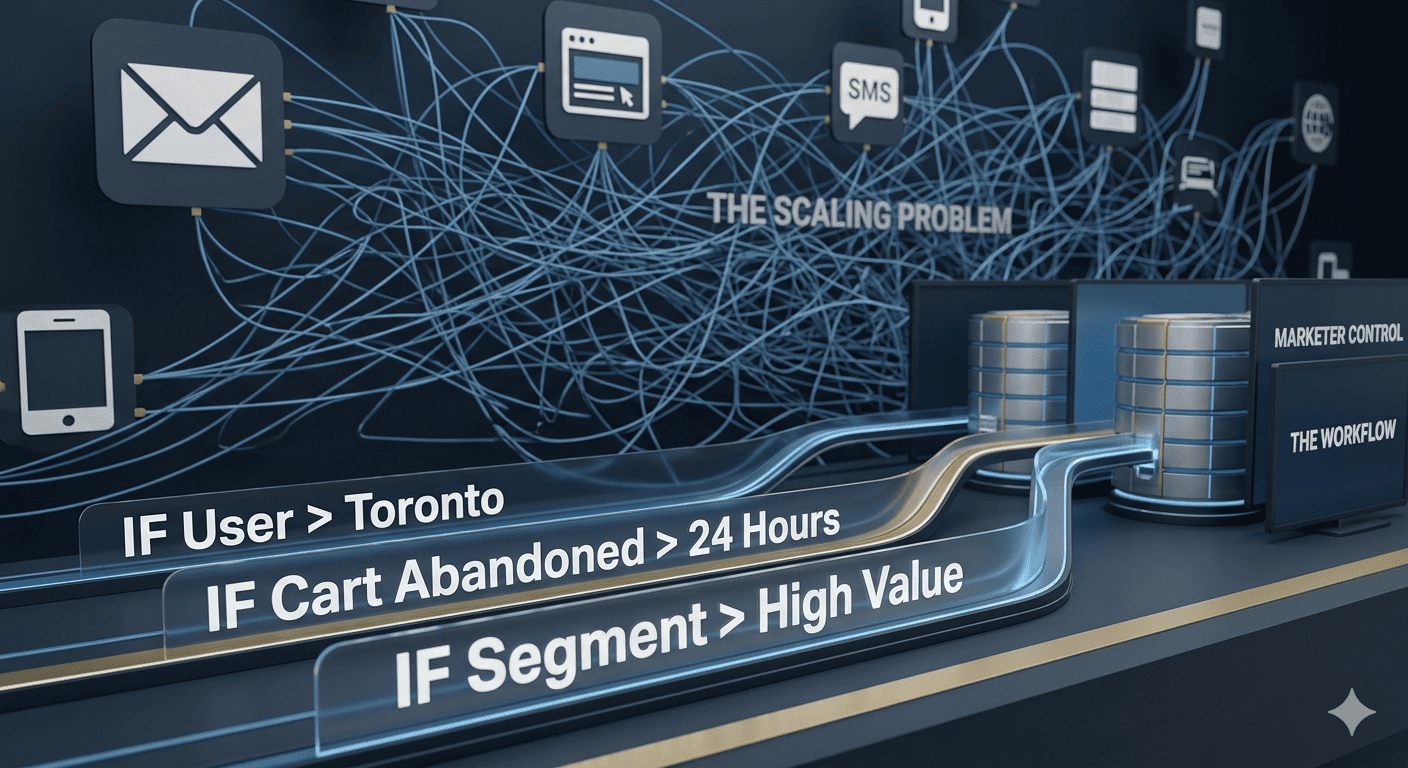
- The Workflow: Marketers create “buckets” based on historical data. You identify a behavior such as “Frequent Shoppers” or “High-Value Leads” and you manually map out a specific journey for that segment.
- The Appeal: The primary draw of rule-based systems is control. Marketers have a direct hand in every interaction. There is no “black box” of AI; if a customer sees a specific banner, it is because a human specifically dictated they should. For highly regulated industries like banking or insurance, this sense of total oversight is often the initial comfort zone.
- The Scaling Problem: The flaw in this model is that human logic does not scale at the same rate as digital data. To offer a truly personal experience to a database of 10 million people, you would theoretically need thousands of unique rules to cover every edge case and nuance. This leads to what we call “Rule Explosion.”
The “Wall” of Rule-Based Systems
Consider the operational reality of a global retail bank with 5 million active customers. To personalize a homepage for different personas, the marketing team starts with 50 rules. They then want to cross-sell 5 different product lines across 5 different regions. Suddenly, you have 1,250 unique combinations to manage, test, and update. This is where human bandwidth hits a ceiling. The system becomes a “tangled mess” of conflicting logic where updating one rule might accidentally break three others. This is the Operational Wall: a point where your team spends 90% of their time managing spreadsheets and 10% on creative strategy. It is reactive, often relying on data that is hours or even days old, meaning you are personalizing for who the customer was, not who they are.

2. The Disruptor: Real-Time Personalization
Real-Time Personalization represents a paradigm shift. It is the transition from “broad segments” to “individual moments.” It doesn’t wait for a user to fall into a pre-defined bucket; it adapts the digital experience during the live session, responding to digital signals as they are generated.

a. The Workflow: This method uses machine learning to process streaming data. It looks at “micro-signals” and the millisecond a user hovers over a product, the sequence of pages they visit in a single minute, their current local weather, or their immediate search intent.
b. The “Speed” Factor: In a real-time environment, the system doesn’t care about “Yesterday’s Persona.” If a user who usually buys business suits for work suddenly starts clicking on baby clothes at 11:00 PM, a real-time system recognizes the shift in intent instantly. It pivots the homepage to surface nursery gear and strollers while the user is still on the site. A rule-based system, by contrast, would continue showing that user blazers and ties for another week until the “nightly sync” catches up.
c. The Scaling Advantage: Real-time AI is built for the “Long Tail” of customer behavior. Because it relies on self-learning algorithms, the operational effort for your marketing team remains constant whether you are serving 10,000 customers or 100,000,000. The AI handles the complexity, allowing your team to act as “Orchestrators” rather than “Manual Laborers.”
3. The Showdown: Comparison at a Glance
|
Feature |
Rule-Based ⚙️ |
Real-Time ⚡ |
|
Logic Origin |
Human-defined “If/Then” rules |
AI-driven predictive models |
|
Data Recency |
Historical (Last week/sync) |
Instant (The last millisecond) |
|
Operational Effort |
Increases exponential with scale |
Remains constant and automated |
|
User Experience |
Segment-based and rigid |
Individual-based and fluid |
|
Success Metric |
Accuracy within a group |
Relevance to an individual |
4. Why Real-Time is the Only Way Forward
While rule-based personalization still has a place for broad, brand-wide seasonal campaigns such as a “New Year Sale” banner shown to everyone in a specific country, it is fundamentally incapable of handling the Complexity of the Customer Journey. Today’s consumer is a “channel-hopper.” Their journey is non-linear and chaotic. They might see an ad on Instagram while commuting, browse on a laptop during their lunch break, and finally make the purchase via a mobile app while watching TV in the evening.

A rule-based system, operating in silos, often sees these as three different people. It fails to connect the dots in the moment, resulting in fragmented messaging, like sending a “Buy Now” email for a product the customer already purchased on their phone ten minutes ago. A real-time system, powered by a sophisticated data backbone, unifies these signals instantly. It creates a “Single Customer View” that moves with the user, ensuring that the brand conversation is seamless, consistent, and respectful of the customer’s time.
5. How Lemnisk Solves the Scalability Crisis
At Lemnisk, we recognize that the move to real-time personalization can feel daunting. That is why our AI-Powered Customer Data Platform (CDP) is designed specifically to dismantle the complexity of scaling. We provide the infrastructure that allows enterprises to act with the speed of a startup and the precision of a scientist.
1. The Ramanujan AI Engine
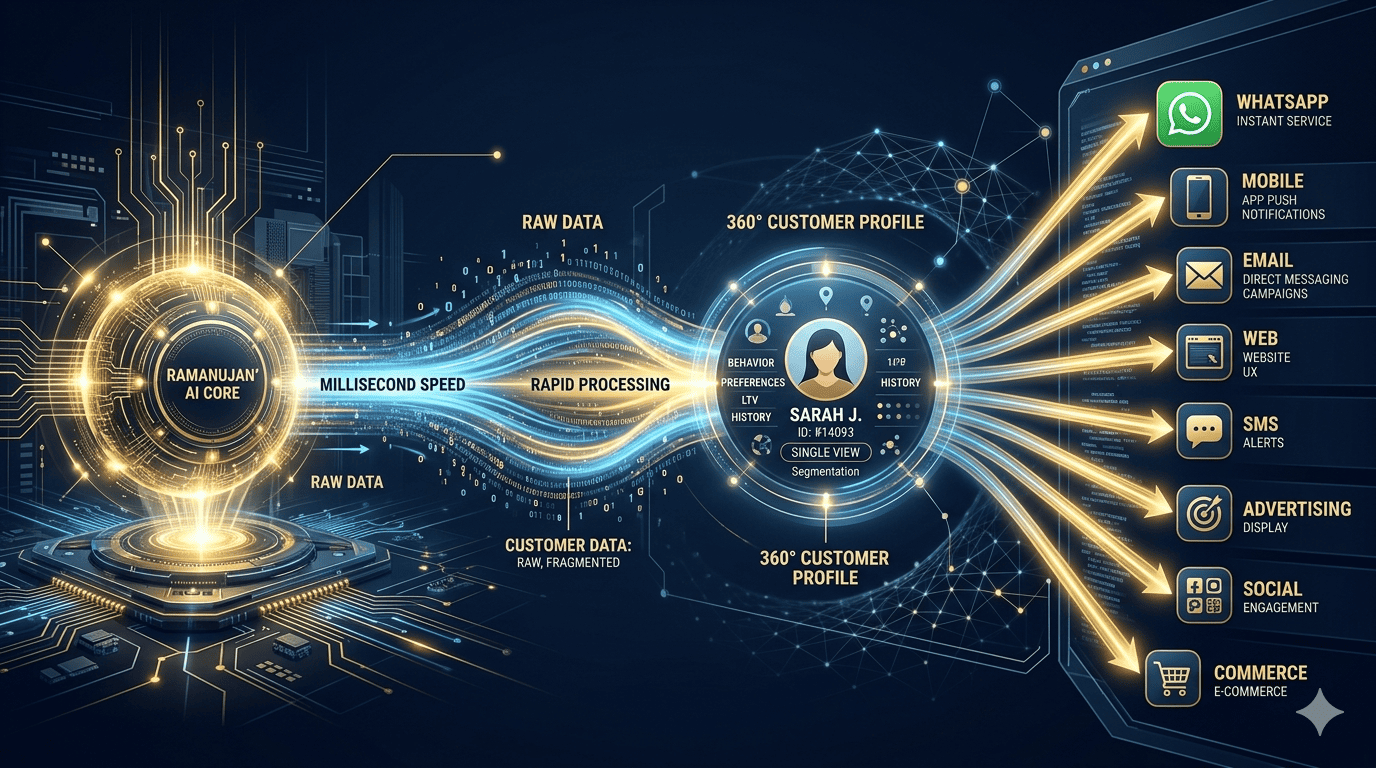
The heartbeat of our platform is the Ramanujan AI Engine. Named after the legendary mathematician who found patterns where others saw chaos, this proprietary engine does the heavy lifting for your team. It doesn’t just sort data; it predicts behavior. By analyzing millions of data points in real-time, Ramanujan determines the Next Best Action for every individual user. It moves your strategy beyond “buckets” and into Predictive Orchestration, deciding the right message, the right channel, and the right moment to engage, all without a single manual rule.
2. Hyper-Personalization at Millisecond Speed
Latency is the enemy of conversion. If your personalization takes three seconds to load, your customer has already scrolled past. Lemnisk’s architecture is built for high-velocity data. We resolve identities across fragmented, siloed sources to create a 360-degree profile that updates in the blink of an eye. Whether a customer is interacting with your mobile app or walking into a physical branch, Lemnisk ensures that your brand’s response is tailor-made in the millisecond it matters most.
3. True Omnichannel Activation
Scaling means being present wherever your customer chooses to be. Lemnisk doesn’t just personalize your website; it orchestrates unique journeys across the entire digital ecosystem. From WhatsApp and SMS to Email, Push Notifications, and Social Retargeting, Lemnisk ensures your brand speaks with one intelligent voice. We eliminate the “broken telephone” effect of multi-channel marketing, replacing it with a unified experience that drives measurable ROI.
Final Thoughts: The Cost of Doing Nothing
In the current economic climate, efficiency is the ultimate competitive advantage. The digital world is moving too fast for manual rules and “nightly data syncs.” If your marketing team is spending more time managing the “plumbing” of your personalization rules than they are on high-level creative strategy, you aren’t scaling, you’re just staying busy.

Rule-based personalization was a great start as it was the necessary first step in our digital evolution. But in an era of infinite choice and lightning-fast intent, real-time AI is the finish line. Every second of delay in your data is a lost opportunity to connect with a customer. By shifting to an intelligent, automated approach with Lemnisk, you can finally deliver the 1-to-1 experience your customers expect, without the manual overhead or the scaling nightmare. It’s time to stop managing rules and start driving growth.
Ready to see real-time personalization in action? Get a demo with us today!

Leave a Reply