Every marketer has been there. You send a perfectly crafted email to a prospect, only to find out they had already called your support team, browsed three product pages, and abandoned a form all before your email even landed. You were communicating, but you were not listening. And more importantly, you were not connected.
This is the gap that journey orchestration was built to close.
As customer expectations evolve and the number of touchpoints multiplies, marketers are realizing that running campaigns is no longer enough. What you need is the ability to guide each customer through a journey that feels personal, timely, and consistent regardless of where they are or what channel they use. That is exactly what journey orchestration delivers.
What Is Journey Orchestration?
Journey orchestration is the process of designing, automating, and optimizing personalized customer experiences across multiple channels and touchpoints in real time.
Unlike traditional campaign management, which is linear and marketer-driven, journey orchestration is dynamic and customer-driven. It responds to what a customer does, not just what a marketer plans. If a customer clicks an ad, opens a message, visits a webpage, or drops off mid-funnel, the journey adapts accordingly triggering the next best action in that moment.
Think of it as the difference between a scripted play and an improvised conversation. Traditional campaigns follow a fixed script. Journey orchestration listens, responds, and evolves based on the customer in front of you.
Why Traditional Campaign Marketing Falls Short

For years, marketers relied on batch-and-blast campaigns, segmented email lists, and scheduled push notifications. These approaches worked when customers interacted with brands through one or two channels. But today, a single customer might touch your brand through a paid ad, your website, a WhatsApp message, a call center interaction, and an in-app notification sometimes within the same day.
The problem with traditional marketing in this environment is threefold.
First, it is channel-centric rather than customer-centric. Each channel operates in its own silo, with its own data and its own logic. A customer who opts out of email might still get bombarded with SMS. A prospect who just converted might still be served acquisition ads.
Second, it is reactive rather than real-time. Campaigns are built in advance and executed on a schedule. They cannot respond to a customer who just abandoned a loan application or just browsed a premium insurance plan.
Third, it lacks personalization at scale. Segmenting audiences into broad buckets is not the same as treating each customer as an individual. Customers today expect brands to know their preferences, their history, their intent and to communicate accordingly.
Journey orchestration addresses all three of these gaps.
How Journey Orchestration Works
At its core, journey orchestration relies on four capabilities working in harmony.
- Unified Customer Data
You cannot orchestrate a journey if you do not know who the customer is. Journey orchestration starts with a unified view of each individual pulling together behavioral data, transactional history, demographic information, and real-time signals from every online and offline touchpoint. This unified customer profile becomes the foundation for every decision the system makes.
- Real-Time Triggers and Decision Logic
Once you have unified data, the journey orchestration platform uses predefined rules and AI-driven logic to determine the next best action for each customer at any given moment. Did a customer just spend five minutes on a product page? Trigger a personalized follow-up. Did a user abandon a checkout flow? Send a timely reminder on the channel they are most likely to respond to. The decisions happen in milliseconds, not days.
- Cross-Channel Execution
Journey orchestration does not favor one channel over another. It coordinates messaging across email, SMS, push notifications, WhatsApp, in-app messages, web personalization, and more ensuring the cross-channel customer experience feels seamless no matter where the customer engages. The channel is chosen based on where the customer is most active and most likely to convert, not based on what is easiest for the marketer.
- Continuous Optimization
The journey does not end once a message is sent. Journey orchestration platforms monitor how customers respond, track conversion rates across different paths, and continuously refine the logic to improve outcomes. Over time, the system gets smarter learning which sequences, timings, and messages work best for which customer profiles.
What Does Journey Orchestration Look Like in Practice?
Consider a bank trying to convert leads for a home loan product.
Without journey orchestration, the bank might run a series of scheduled email campaigns to a broad list of prospects, regardless of where each person is in their decision process. Some get the right message at the right time by chance. Most do not.
With a journey orchestration platform, the moment a prospect visits the home loan page, a unified profile is created or updated. If they spend significant time reading through eligibility criteria but do not apply, the system triggers a personalized follow-up, perhaps an SMS with an EMI calculator, or an in-app notification with a limited-time offer. If they start an application but drop off midway, the journey adapts to routing them to a call center agent with full context, or sending a helpful email that addresses common concerns.
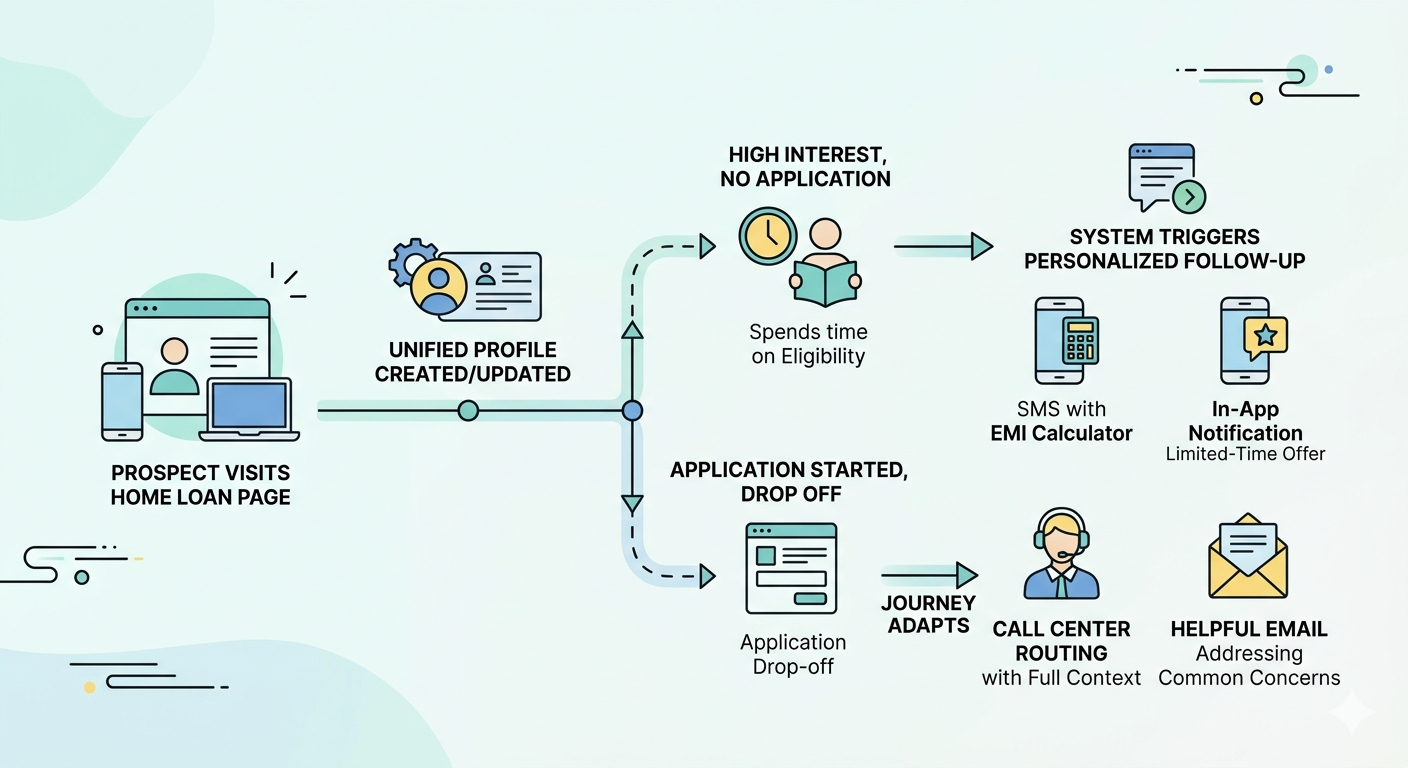
Every step is connected. Every message is relevant. And the journey continues to adapt until the customer converts or until the system determines they need a different approach.
This is what personalized customer journey orchestration looks like in action.
Key Benefits of Journey Orchestration for Modern Marketers

Implementing a journey orchestration platform delivers measurable benefits across the marketing funnel.
1. Higher Conversion Rates: By delivering the right message at the right moment, journey orchestration reduces drop-offs at critical funnel stages and increases conversion across products and segments.
2. Improved Customer Retention: Personalized journeys do not stop at acquisition. Journey orchestration helps brands stay relevant post-conversion driving renewals, upsells, and long-term loyalty.
3. Reduced Marketing Waste: Instead of sending mass communications to broad segments, journey orchestration focuses effort on high-intent signals making every marketing rupee work harder.
4. Faster Time to Market: Visual customer journey builders allow marketers to design and launch complex workflows without depending on engineering teams reducing time from insight to execution.
5. Better Cross-Team Alignment: When all channels are orchestrated through a single platform, marketing, CRM, and customer experience teams work from the same customer view eliminating duplication and inconsistency.
Industries Where Journey Orchestration Delivers the Most Impact

Journey orchestration is not limited to one sector. Across industries, brands are using it to solve high-stakes customer experience challenges.
a. Banking and Financial Services: Reducing drop-offs in loan and credit card applications, onboarding new account holders, and cross-selling products based on financial behavior.
b. Insurance: Guiding prospects from awareness to policy purchase, re-engaging lapsed customers, and personalizing renewal communications.
c. Retail and E-commerce: Recovering abandoned carts, personalizing product recommendations, and building post-purchase loyalty journeys.
d. Telecom: Reducing churn through proactive engagement, upselling data and plan upgrades, and improving onboarding experiences for new subscribers.
e. Travel and Hospitality: Personalizing booking journeys, re-engaging browsed-but-not-booked travelers, and driving repeat visits through loyalty programs.
Why Journey Orchestration Matters More Than Ever
Customer attention is scarce. Competition across industries is intense. And customers have more choices than ever before.
In this environment, the brands that win are not necessarily those with the biggest budgets or the most channels. They are the ones that make every interaction feel personal, relevant, and timely. Journey orchestration is what makes that possible at scale.
It shifts the conversation from “how many messages did we send?” to “how meaningful was each interaction?” And that shift in mindset is what separates transactional marketing from genuine customer experience.
For any brand serious about growth, customer retention, and long-term loyalty, investing in a journey orchestration platform is no longer optional; it is a strategic imperative.
The 4 Pillars of Journey Orchestration with Lemnisk
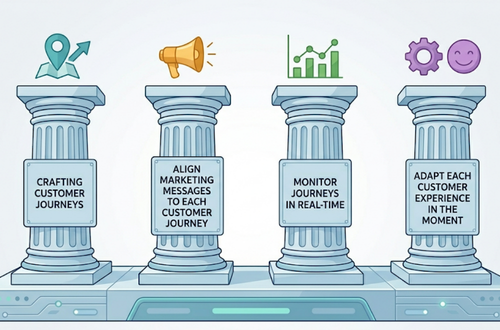
When it comes to executing journey orchestration at scale, Lemnisk’s Customer Journey Builder is built around four core capabilities that take marketers from strategy to execution seamlessly.
1. Crafting Customer Journeys
Marketers are constantly looking for ways to design unique journeys for their customers, but most tools make complexity a barrier. Lemnisk removes that barrier entirely. With Lemnisk’s Customer Journey Builder, marketers can craft both simple and complex user journeys through an intuitive drag-and-drop interface with no engineering dependency required. Beyond workflow design, the platform allows teams to map customer personas with cross-channel interactions, ensuring that every journey is built around who the customer actually is, not just where they clicked last.
2. Align Marketing Messages to Each Customer Journey
A journey is only as good as the data behind it. Marketers must integrate customer data from all offline and online channels to derive insights that are truly actionable. Lemnisk’s AI-powered platform does exactly this ingesting and unifying data from various digital and physical interactions to build a complete picture of each individual customer. The result is marketing campaigns that are not just personalized in tone but aligned with the actual stage and intent of each customer’s journey. Every message feels relevant because it is built on real behavior, not assumptions.
3. Monitor Journeys in Real-Time
Monitoring marketing campaign effectiveness has always been challenging but waiting days or weeks for performance data is no longer acceptable. Lemnisk enables marketers with the power to control and monitor customer journeys in real time, giving teams the visibility they need to identify what is working and course-correct what is not. Whether a journey is underperforming at a specific stage or a segment is responding better than expected, Lemnisk puts that intelligence in your hands the moment it happens so you can optimize campaigns while they still matter.
4. Adapt Each Customer Experience in the Moment
Customer behavior does not follow a script, and neither should your journeys. When a customer changes direction, abandons a flow, responds to a new trigger, or signals a shift in intent Lemnisk’s platform detects that change and responds instantly. Marketers can orchestrate each behavioral shift into a positive experience, guiding customers back into the journey or routing them to a more relevant path. This ability to adapt in the moment is what separates journey orchestration from traditional campaign execution and it is what makes Lemnisk a platform built for the way customers actually behave.
Ready to Build Journeys That Actually Convert?
If your marketing still relies on scheduled campaigns, broad segments, and disconnected channels, you are leaving conversion and loyalty on the table. Lemnisk’s Journey Orchestration platform gives you everything you need to craft, align, monitor, and adapt customer journeys at scale in real time, across every channel.
Ready to see what journey orchestration looks like for your business? Get a demo with Lemnisk today and start building journeys that truly resonate.

Leave a Reply