By building your MarTech stack around a composable CDP, you gain the flexibility to integrate best-in-class tools, eliminate data silos, and deliver personalized customer experiences at scale without being locked into a monolithic platform.
What Is a Composable CDP and Why Does It Matter?
A Customer Data Platform (CDP) unifies customer data from across your organization into a single, persistent profile. A Composable CDP takes this a step further: instead of a packaged, all-in-one solution, it’s an architectural approach that leverages your existing data warehouse (like Snowflake, BigQuery, or Databricks) as the foundational layer.
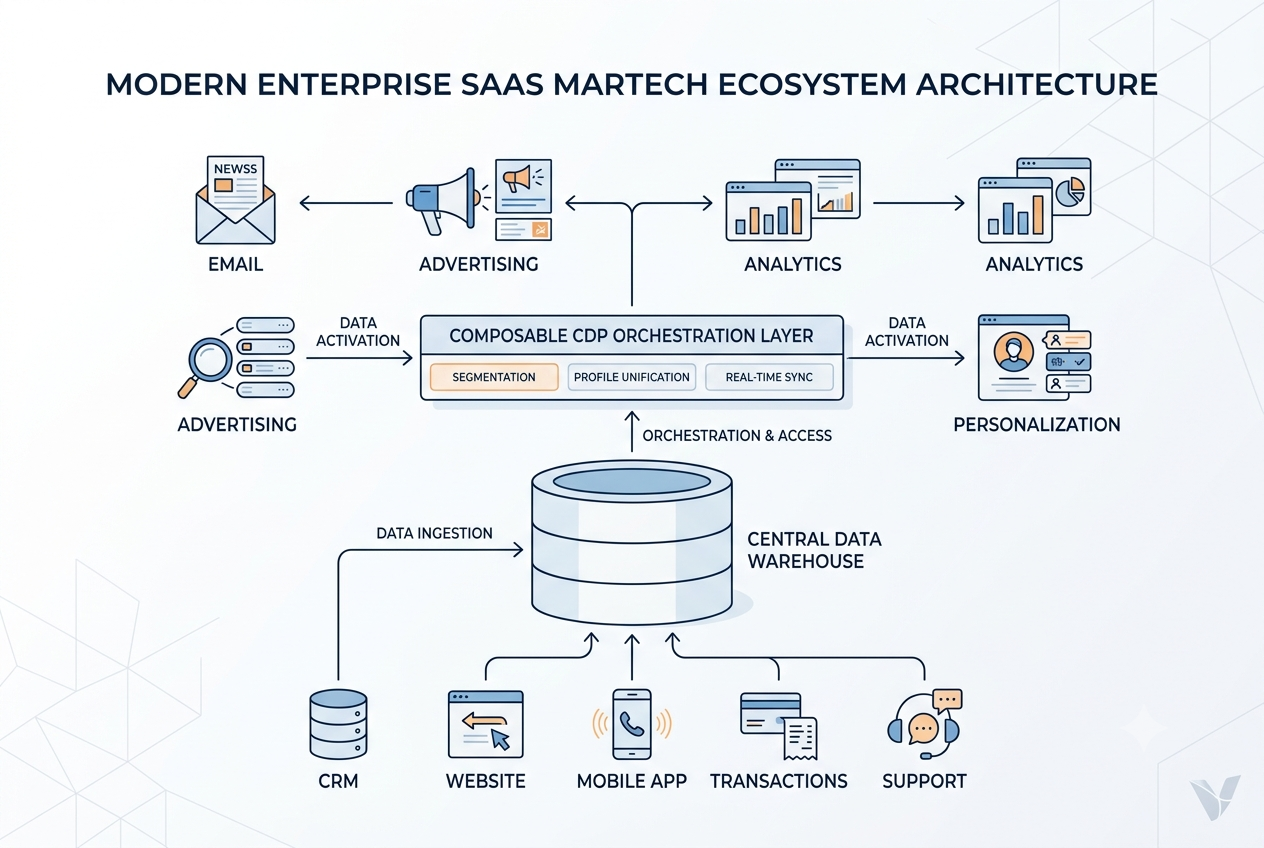
Rather than moving all your data into a proprietary CDP system, a composable CDP brings the intelligence to where your data already lives. This “reverse ETL” model means your customer data never leaves your warehouse; you simply build activation, segmentation, and orchestration layers on top of it.
For marketers and data teams, this distinction is critical. Traditional CDPs often create yet another silo. A composable CDP, by contrast, becomes the connective tissue of your entire MarTech stack making it the ideal hub around which to build.
Why Build Your MarTech Stack Around a Composable CDP?
Before diving into how, it’s worth understanding why the composable CDP deserves to be the centerpiece of your stack, not just another tool in it.
1. A single source of truth for customer data. Every tool in your MarTech stack, your email platform, ad networks, CRM, personalization engine draws from the same unified customer profiles. No more inconsistent segments or stale data.
2. Flexibility without vendor lock-in. You can swap out execution tools (email ESPs, paid media platforms, analytics) without rebuilding your data foundation. Your warehouse remains constant; your stack evolves around it.
3. Real-time activation at scale. Composable CDPs enable you to push enriched audience segments to downstream tools in near real-time, enabling timely, personalized outreach across channels.
4. Reduced data duplication and cost. Since data stays in the warehouse, you avoid costly ETL pipelines and redundant storage across multiple platforms.
Step-by-Step: Building a MarTech Stack Around a Composable CDP
Step 1: Establish Your Data Warehouse as the Foundation

Your composable CDP is only as strong as the data infrastructure beneath it. Start by consolidating all customer data transactional, behavioral, demographic, and engagement data into a modern cloud data warehouse.
Key actions:
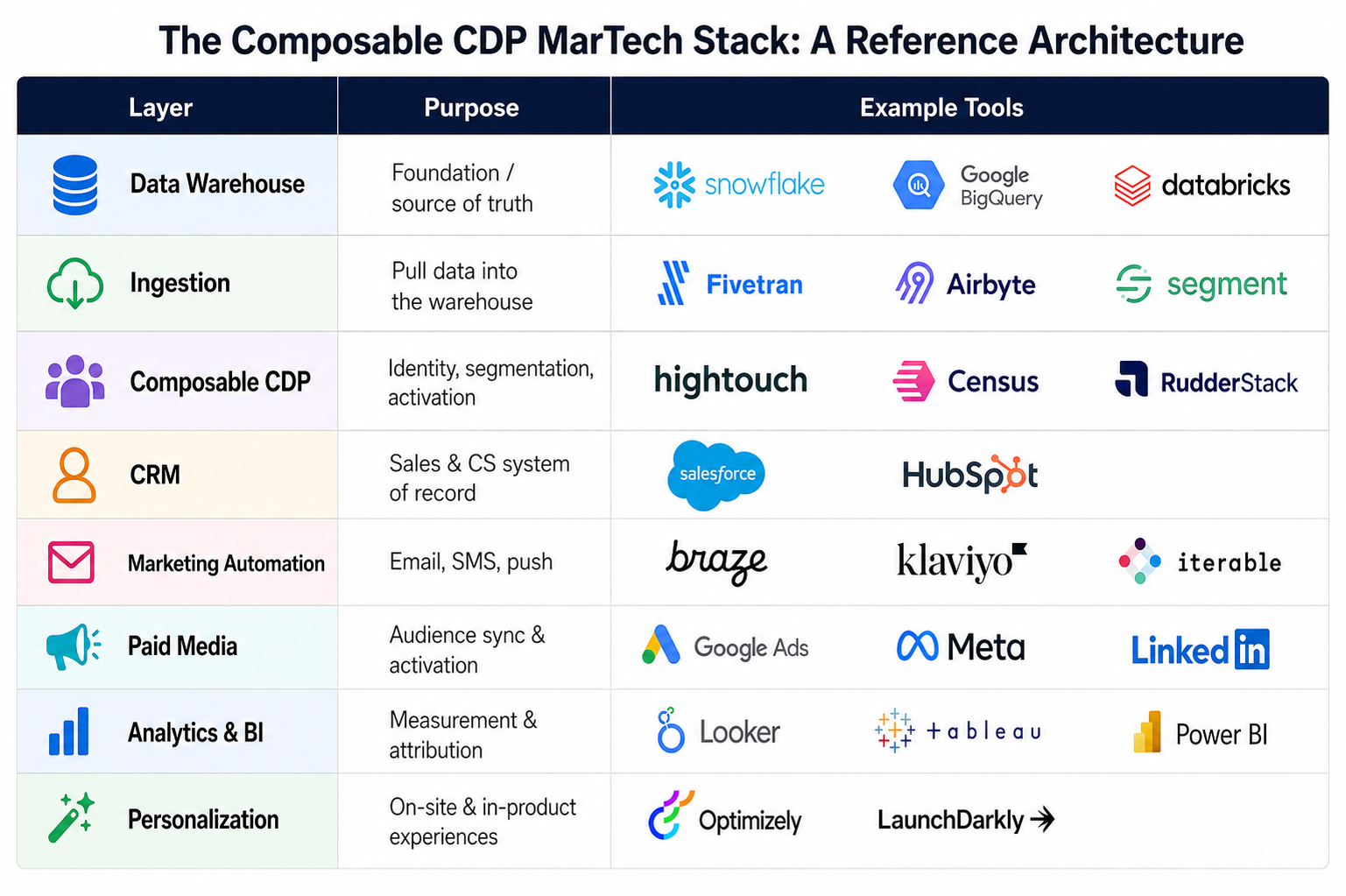
- Choose a warehouse: Snowflake, Google BigQuery, Amazon Redshift, or Databricks are the most common choices.
- Implement a data ingestion pipeline using tools like Fivetran, Airbyte, or Stitch to pull data from all your sources.
- Establish data governance practices: consistent naming conventions, identity resolution logic, and data quality checks.
This warehouse becomes the “brain” of your MarTech stack. Everything downstream reads from and writes back to it.
Step 2: Layer on Composable CDP Capabilities

With your warehouse in place, add the composable CDP layer. This typically includes:
- Identity resolution stitching together anonymous and known user data across devices and sessions into unified profiles.
- Audience segmentation building dynamic, SQL-based or no-code segments that update as data changes.
- Reverse ETL syncing segments and enriched profiles from the warehouse to downstream tools (your CRM, ad platforms, email tools).
Popular composable CDP platforms and tools include Census, Hightouch, Segment (with warehouse-native mode), and RudderStack. Some organizations also build composable CDP capabilities natively using dbt + a reverse ETL tool.
Step 3: Connect Your CRM

Your CRM (Salesforce, HubSpot, Dynamics) is often the “system of record” for sales and customer success. By connecting it to your composable CDP, you ensure:
- Sales reps see the full behavioral history of a lead, not just what’s been manually entered.
- CRM contacts are enriched with product usage, web activity, and purchase history from the warehouse.
- Lifecycle stage changes in the CRM trigger downstream actions across other MarTech tools.
The connection is bidirectional: the CRM pushes lead and contact data into the warehouse, and the composable CDP pushes enriched signals back to the CRM.
Step 4: Integrate Your Marketing Automation and Email Platform

Email and marketing automation tools Marketo, Klaviyo, Braze, Iterable, HubSpot Marketing are where most customer communications are executed. Feeding them with composable CDP segments dramatically improves relevance.
Instead of building segments natively inside each email tool (which leads to inconsistency), you define segments once in your composable CDP and sync them to every execution tool. This means:
- A “high-intent free trial user” segment defined in your warehouse flows into Klaviyo for an email sequence, Braze for a push notification, and Intercom for an in-app message all simultaneously.
- Behavioral triggers (e.g., “user visited pricing page 3 times in 7 days”) fire in real time without re-implementing logic in every tool.
Step 5: Activate Paid Media with Audience Syncing

One of the highest-ROI use cases for a composable CDP is paid media activation. Sync warehouse-built audiences directly to Google Ads, Meta, LinkedIn, and programmatic platforms.
This enables:
- Suppression lists exclude current customers from acquisition campaigns to reduce wasted spend.
- Lookalike modeling upload high-value customer segments as seeds for platform-based lookalike audiences.
- Retargeting precision retarget users based on specific product behaviors, not just website visits.
Because the audience logic lives in your warehouse, it’s consistent across every ad platform eliminating the discrepancies that arise when segments are built independently in each channel.
Step 6: Add an Analytics and BI Layer

Your composable CDP already lives in the warehouse, which makes analytics a natural extension. Connect a BI tool Looker, Tableau, Power BI, or Metabase to the same warehouse tables that power your CDP.
This gives marketing, product, and revenue teams a shared view of customer behavior, campaign performance, and funnel health. It also closes the attribution loop: you can analyze which MarTech touchpoints are actually influencing conversion, with full data lineage.
Step 7: Enable Personalization and Product Experiences

Finally, extend your composable CDP into on-site and in-product personalization. Tools like Optimizely, LaunchDarkly, or a custom API layer can query the warehouse (or a feature store synced from it) to serve personalized content, product recommendations, or feature flags based on rich customer profiles.
This is where the composable CDP’s value truly compounds: the same unified profile that powers your email campaigns and paid ads now drives real-time personalization across every digital touchpoint.
The Composable CDP MarTech Stack: A Reference Architecture
Common Pitfalls to Avoid
Don’t skip identity resolution. If your warehouse has fragmented customer records, your composable CDP will produce low-quality segments. Invest in proper identity stitching before activating data downstream.
Don’t treat it as a one-time project. A composable CDP is a living system. Audience definitions, data models, and integrations need regular maintenance as your business evolves.
Don’t underinvest in data governance. With more flexibility comes more responsibility. Establish clear ownership of data models, documentation standards, and access controls from day one.
Final Thoughts
Building a MarTech stack around a composable CDP is not just a technical decision it’s a strategic one. It means committing to a data-first marketing approach where every tool in your stack is powered by the same trusted, warehouse-native customer profiles.
The result is a MarTech ecosystem that’s more coherent, more cost-effective, and dramatically more capable of delivering the personalized, real-time experiences that modern customers expect.
Start with your data foundation, layer in composable CDP capabilities, and connect your execution tools systematically. The composable CDP won’t just sit in your stack, it will define it.
Looking to implement a composable CDP for your organization? Start by auditing your existing data sources and identifying where customer data currently lives. That’s your foundation; everything else builds from there. Request a Demo.

Leave a Reply