Customer data already has a home. It sits in Snowflake, BigQuery, Databricks, or Redshift, modelled by data teams, governed by security teams, and trusted by finance and risk teams. Yet every time marketing needs to act on that data, the first step is usually to copy it somewhere else.
That copy is where problems begin. Records go stale, definitions drift, and compliance teams lose visibility into where personal data lives. A warehouse-native CDP removes the copy and activates data in place.
What is a warehouse-native CDP?

A warehouse-native CDP is a customer data platform that uses the enterprise data warehouse as its source of truth and its processing layer. Instead of ingesting customer data into a separate proprietary store, it reads from the warehouse, builds audiences and computes traits there, and sends instructions to marketing channels from that single location.
Traditional CDPs work the other way around. Data is pulled out of source systems, loaded into the CDP’s own database, unified there, and then pushed to downstream tools. The warehouse becomes one more source feeding a parallel system.
A warehouse-native approach treats the warehouse as the center. The CDP becomes a layer of intelligence and activation on top of it, not a second database beside it.
Why the traditional CDP model is under pressure
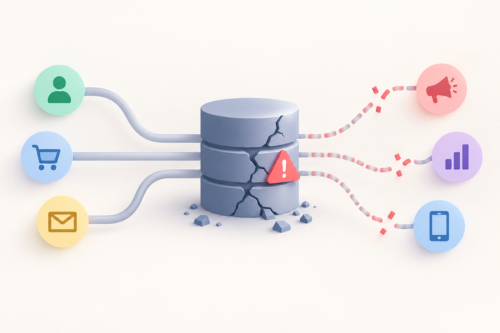
Several shifts have made the copy-everything model harder to justify.
First, warehouses have matured. Cloud data platforms now handle identity resolution, large-scale transformations, and near real-time workloads that once needed specialized systems. Most enterprises have already invested heavily in modelling customer data there.
Second, data duplication creates risk. Each additional copy of customer data introduces another system to secure, audit, and reconcile. This risk becomes even greater in regulated industries such as banking, insurance, and healthcare, where every extra copy widens the compliance surface.
Beyond security risks, trust in numbers has also become a boardroom issue. When marketing reports one customer count and finance reports another, the cause often lies in two systems holding different versions of the same data.
Adding to these challenges, data privacy regulations continue to tighten. As rules around consent, residency, and the right to erasure evolve, businesses can meet these requirements more easily when they keep personal data in one governed location.
How a warehouse-native CDP works

The architecture has four working parts.
- Unified data in the warehouse. Customer data from CRM, transaction systems, product usage, support, and web and app behavior lands in the warehouse through existing pipelines. Data teams keep ownership of the models.
- Identity and trait computation. Identity resolution, customer attributes, and scores are computed against warehouse tables. Business definitions such as “active customer” or “high-value segment” are written once and reused everywhere.
- Audience building for business users. Marketers build segments through a visual interface. The CDP translates those definitions into queries that run on the warehouse, so no one has to write SQL and no data leaves the governed environment.
- Activation to channels. Audiences and signals are sent to email, SMS, push, WhatsApp, ad platforms, and web personalization tools. Only the specific attributes a channel needs are passed on, not entire customer profiles.
Benefits of activating data in the warehouse

One source of truth
When every team reads from the same tables, definitions stay consistent. Campaign reporting, finance reporting, and product analytics reconcile because they share an origin.
Stronger governance and security
Access controls, masking policies, encryption, and audit logs already exist in the warehouse. A warehouse-native CDP inherits them instead of rebuilding them. For BFSI, healthcare, and insurance organizations, this simplifies security reviews and shortens procurement cycles.
Lower data movement and storage cost
Eliminating the second copy reduces storage duplication, pipeline maintenance, and the engineering effort spent keeping two systems in sync.
Fresher data
Without a batch sync between the warehouse and a CDP database, audiences reflect the current state of the data. Campaigns trigger on what customers did recently, not on last night’s export.
Faster time to value for data teams
Data engineers stop building and monitoring duplicate pipelines. Marketing teams stop filing tickets for every new segment. Both work from the same foundation.
Flexibility
Because the warehouse remains the center, tools around it can change. A new channel, a new analytics product, or a new AI use case can plug into the same data without a migration.
Warehouse-native versus composable: how they relate

The two terms overlap, and they are often used interchangeably, but they are not identical.
A composable CDP is built from modular components for collection, identity, audience management, decisioning, and activation. Organizations adopt the pieces they need and connect them to existing infrastructure. Warehouse-native describes where the data lives and where computation runs.
In practice, the strongest composable architectures are warehouse-native. Modularity gives flexibility at the application layer, and the warehouse gives consistency at the data layer.
</p>
Where a hybrid approach still mak
es sense

Warehouse-native does not mean warehouse-only. Some use cases are sensitive to latency. Real-time personalization on a website, in-session recommendations, and instant triggers after an app event cannot always wait on a warehouse query.
A practical architecture therefore pairs the warehouse with a real-time layer. Behavioral events are captured and acted on in milliseconds, while the warehouse remains the system of record for history, identity, and modelled attributes. The two stay in sync so that real-time decisions use warehouse-grade context.
Use cases across industries
BFSI. Banks and lenders can build propensity models in the warehouse, such as likelihood to apply for a loan or to churn, and activate them across channels without moving sensitive financial data into another system.
Insurance. Policy, claims, and engagement data can be combined to time renewals, cross-sell relevant cover, and flag lapse risk, all under the controls the insurer already audits.
Healthcare. Patient engagement programs can run on governed, consented data that never leaves the compliant environment.
Retail and ecommerce. Purchase history, browsing behavior, and loyalty data can drive replenishment reminders, win-back journeys, and tailored offers from one consistent customer view.
Travel. Booking, search, and loyalty data can power personalized itineraries and timely offers around trip stages.
How to evaluate a warehouse-native CDP

Teams assessing options can use these questions as a checklist.
- Does the platform read from and write to the warehouse directly, or does it quietly build its own copy?
- Which warehouses are supported, and how deep is the integration?
- Can business users build and edit audiences without SQL?
- How does the platform handle real-time events alongside warehouse data?
- Are consent and suppression rules enforced at the point of activation?
- Which activation channels are supported natively?
- How are costs structured as data and query volumes grow?
- Can the platform pass security and compliance review in regulated environments?
Getting started
Most organizations do not need a full re-platform. A sensible path is to audit what customer data already exists in the warehouse and where gaps remain. Next, standardize the core definitions for customer, segment, and lifecycle stage. Then choose one high-value use case, such as a churn win-back or an onboarding journey, and run it end to end from the warehouse. Results from that first use case build the case for broader rollout.
The bottom line
Customer data does not need to travel to be useful. The warehouse already holds the most complete, governed, and trusted version of the customer, and a warehouse-native CDP puts that version to work directly. The outcome is fewer copies, fewer disputes over numbers, and marketing that acts on data the whole organization trusts.
Activate your warehouse data with Lemnisk
Lemnisk’s AI-powered CDP connects to the data infrastructure already in place and turns it into personalized, real-time customer journeys. Book a demo to see it in action.

Leave a Reply