Modern marketing operates in an increasingly complex ecosystem where customer interactions span multiple channels—such as websites, mobile applications, social platforms, offline touchpoints, and more. Each interaction generates valuable data, yet this data often remains fragmented across systems. As a result, marketers struggle to build a consistent and accurate understanding of their customers.
Customer Data Platforms (CDPs) were introduced to address this fragmentation by consolidating data into unified customer profiles. While traditional CDPs have played a significant role in advancing data-driven marketing, they are no longer sufficient for organizations seeking flexibility, scalability, and deeper control over their data.
This has led to the emergence of a more modern approach: the Composable CDP.
A composable CDP is not a single product but a strategic framework. It enables organizations to assemble their customer data infrastructure using modular, best-in-class tools rather than relying on a monolithic platform. For marketers, this approach represents a shift toward greater autonomy, adaptability, and precision in how customer data is managed and activated.
Understanding the Traditional CDP
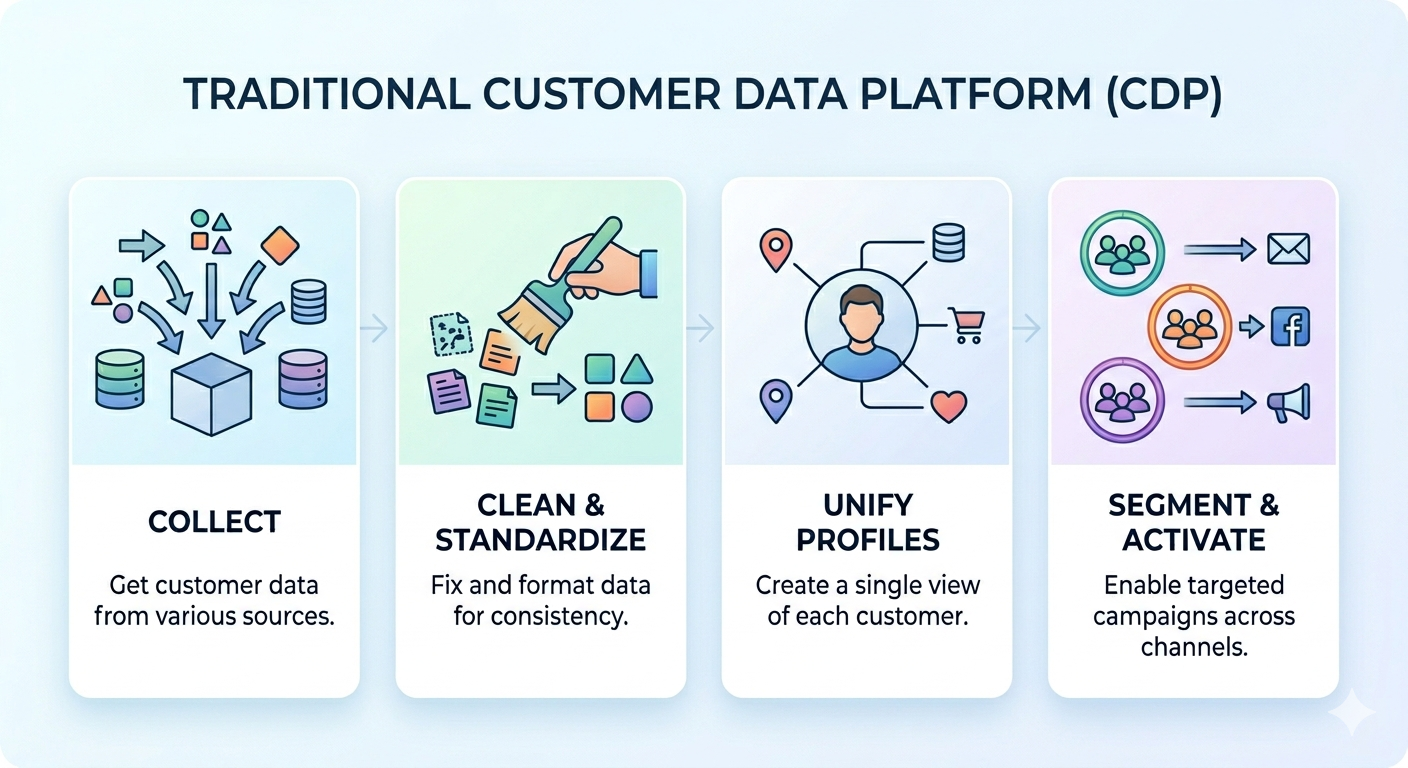
A traditional CDP is designed as an all-in-one system that performs several key functions:
- Collecting customer data from various sources
- Cleaning and standardizing the data
- Creating unified customer profiles
- Enabling segmentation and campaign activation
This centralized approach simplifies implementation and provides a single platform for managing customer data. For many organizations, it serves as a practical starting point.
However, as marketing strategies become more sophisticated and data volumes increase, certain limitations emerge:
- Rigid architecture: Organizations must adapt their workflows to the platform’s capabilities
- Limited integration flexibility: Not all tools integrate seamlessly
- Scalability constraints: Performance and cost may become issues at scale
- Vendor dependency: Switching platforms can be complex and costly
These challenges have encouraged organizations to explore more flexible alternatives.
What is a Composable CDP?
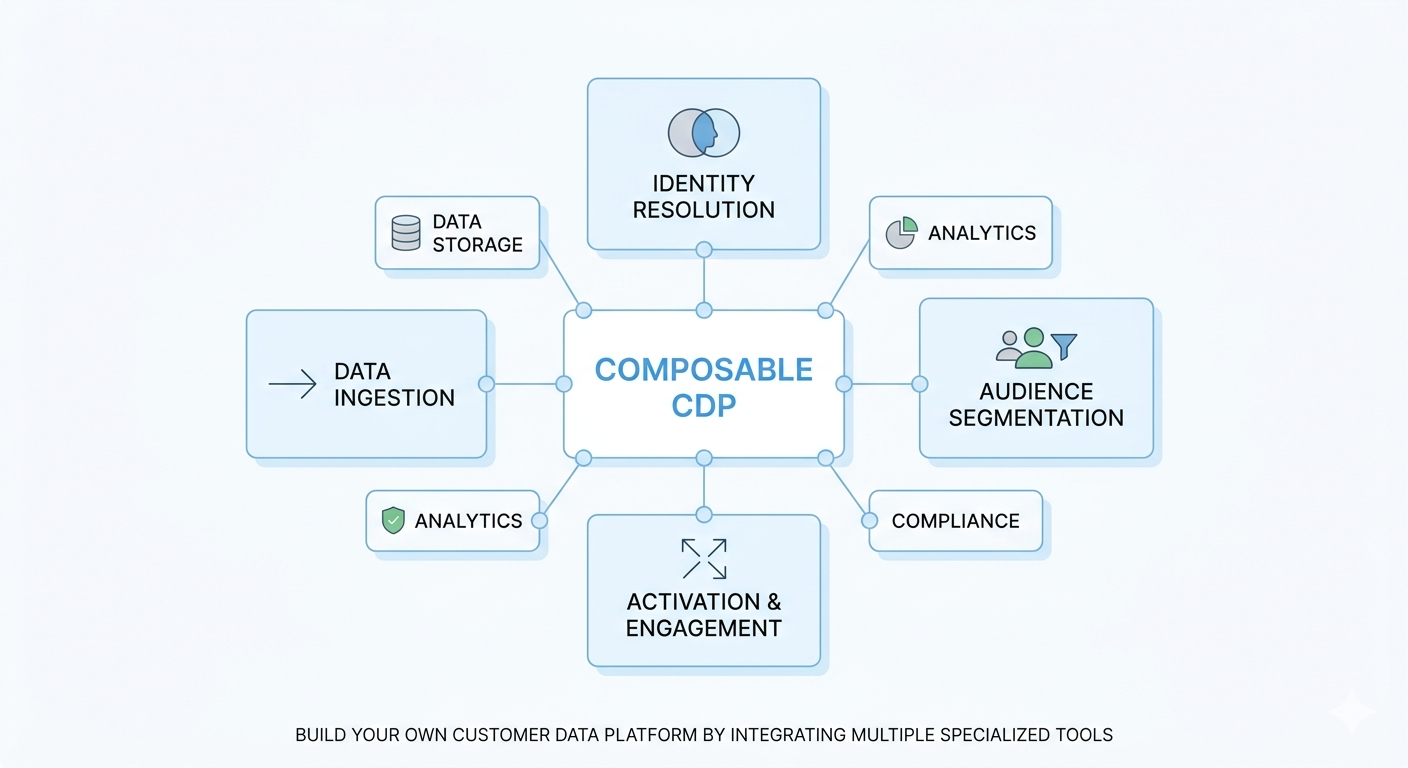
A composable CDP is an architectural approach that allows organizations to build their own customer data platform by integrating multiple specialized tools.
Instead of relying on a single vendor to handle every function, businesses select individual components for data collection, storage, processing, analytics, and activation. These components are connected through APIs, enabling seamless data flow across the ecosystem.
In simple terms, a composable CDP transforms the CDP from a product into a customizable system.
This approach allows organizations to:
- Choose tools that best fit their specific needs
- Replace or upgrade components without disrupting the entire system
- Maintain full control over their data
- Scale efficiently as requirements evolve
Core Principles of a Composable CDP
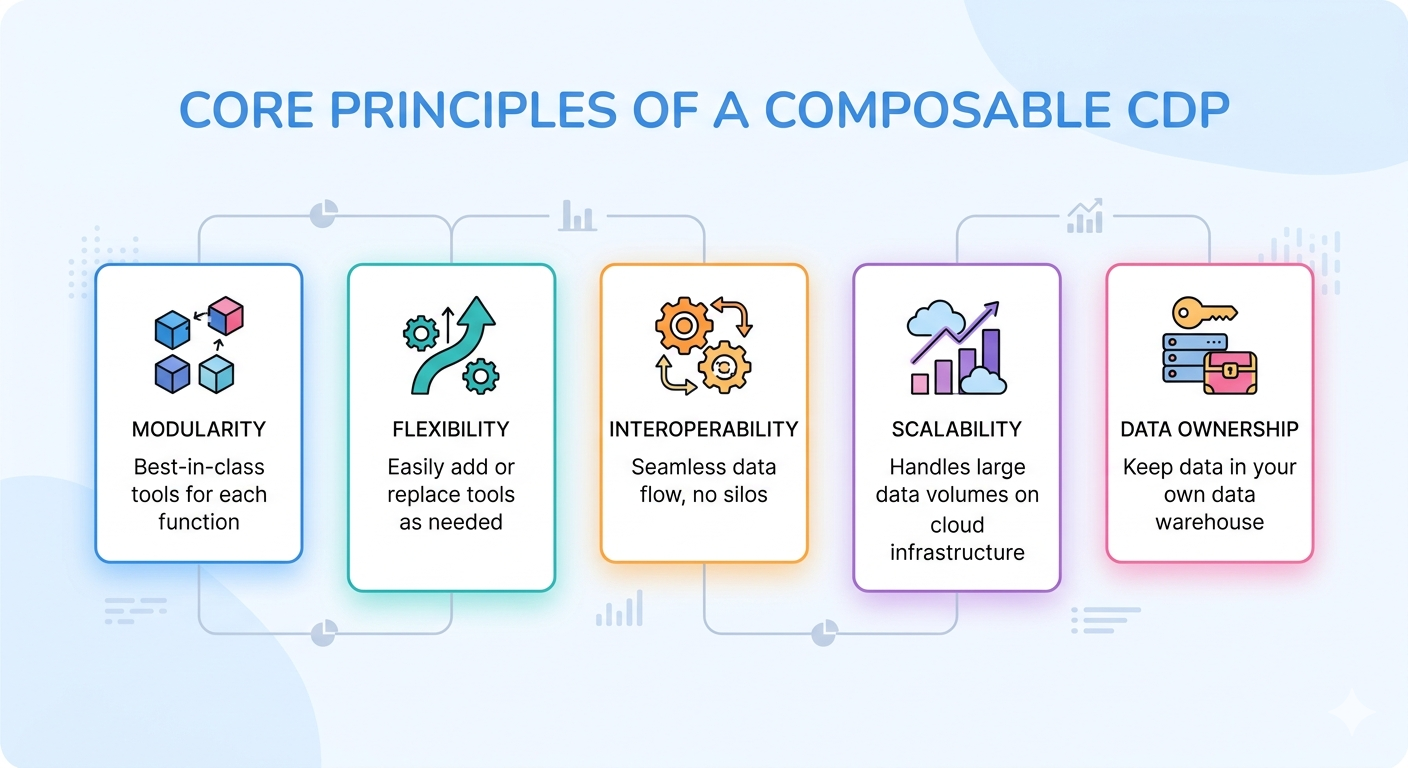
A composable CDP is built on several foundational principles that distinguish it from traditional models.
Modularity
Each function is handled by a dedicated tool. This allows organizations to adopt best-in-class solutions rather than relying on a single vendor’s capabilities.
Flexibility
The architecture can evolve with changing business needs. New tools can be added, and outdated ones can be replaced without major disruptions.
Interoperability
All components are designed to integrate seamlessly, ensuring that data flows freely across systems without creating silos.
Scalability
Composable CDPs are typically built on cloud-based infrastructure, allowing them to handle large volumes of data and complex operations efficiently.
Data Ownership
Organizations retain full control over their data by storing it in their own data warehouses rather than within vendor-controlled environments.
Composable CDP vs Traditional CDP
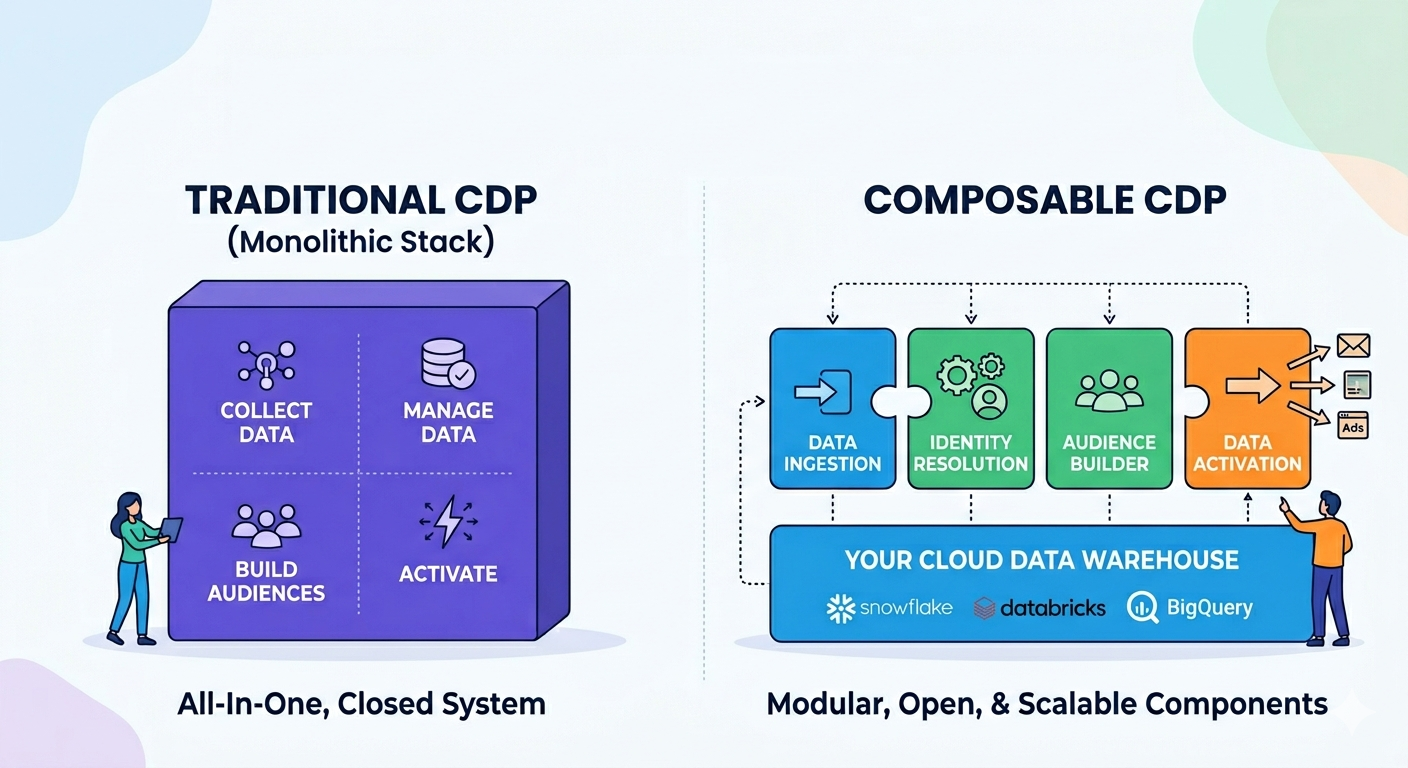
The difference between traditional and composable CDPs lies in their design philosophy.
A traditional CDP offers a centralized, all-in-one solution that prioritizes simplicity and speed of deployment. It is well-suited for organizations with straightforward requirements and limited technical resources.
In contrast, a composable CDP emphasizes flexibility and customization. It allows organizations to design their own architecture using specialized tools, making it ideal for businesses with complex data ecosystems and advanced marketing strategies.
While traditional CDPs provide convenience, composable CDPs provide control. This distinction is critical for organizations aiming to build long-term, scalable data strategies.
To learn more, explore our 2-pager: Traditional CDP vs Composable CDP.
Why Composable CDPs Matter for Marketers
Marketing has evolved from executing campaigns to orchestrating personalized customer experiences across multiple touchpoints. This shift requires deeper insights, faster decision-making, and greater precision.
A composable CDP enables marketers to meet these demands in several ways.
1.Understanding Unified Customer

By integrating data from multiple sources, marketers can create a comprehensive view of each customer. This includes behavioral, transactional, and engagement data.
A unified view enables more accurate targeting and a better understanding of customer journeys.
2. Real-Time Engagement

Customers expect timely and relevant interactions. A composable CDP supports real-time processing, allowing marketers to respond instantly to customer actions.
This enables use cases such as triggered messaging, dynamic content delivery, and real-time personalization.
3. Personalization at Scale

Delivering personalized experiences across large audiences requires robust infrastructure. A composable CDP allows marketers to segment audiences with precision and deliver tailored messages consistently across channels.
4.Improved Campaign Effectiveness

Access to high-quality, unified data enhances campaign performance. Marketers can identify high-value segments, optimize targeting strategies, and measure outcomes more accurately.
Key Components of a Composable CDP
A composable CDP consists of several interconnected components, each responsible for a specific function.
I. Data Collection
Data is gathered from various sources, including digital platforms, CRM systems, and third-party tools.
II. Data Storage
A cloud data warehouse acts as the central repository, ensuring scalability and accessibility.
III. Data Transformation
Data is cleaned, structured, and enriched to ensure consistency and usability.
IV. Identity Resolution
This process links data from different sources to create unified customer profiles. It ensures that interactions across channels are associated with the correct individual.
V. Segmentation
Marketers define audience groups based on behavior, preferences, and other attributes.
VI. Activation
Customer data is delivered to marketing channels such as email platforms, advertising systems, and personalization engines.
When Should Marketers Consider a Composable CDP?

A composable CDP becomes relevant when organizations:
- Require greater customization than traditional CDPs can provide
- Operate across multiple channels and systems
- Prioritize real-time personalization
- Seek full ownership and control of their data
- Aim to scale their marketing operations efficiently
For organizations with evolving and complex data needs, a composable CDP provides a future-ready foundation.
The Future of Customer Data Management
The transition toward composable architectures reflects a broader shift in technology. Organizations are moving away from rigid, monolithic systems toward flexible, modular ecosystems that can adapt to changing requirements.
In the context of marketing, this shift is driven by increasing customer expectations, growing data volumes, and evolving privacy regulations. Marketers must balance personalization with compliance while maintaining efficiency and scalability.
Composable CDPs align with these requirements by enabling organizations to:
- Build strong first-party data strategies
- Ensure transparency and compliance
- Adapt quickly to new technologies and market trends
This positions composable CDPs as a key enabler of modern, data-driven marketing.
To effectively implement this approach, partnering with the right platform is essential. This is where Lemnisk can provide significant value.
Lemnisk enables real-time customer data activation, helping marketing teams deliver personalized and consistent experiences across channels. By integrating seamlessly with existing data environments, it supports organizations in building a scalable and efficient composable CDP strategy.
For businesses looking to enhance their marketing capabilities and move toward a more agile data ecosystem, exploring solutions like Lemnisk can be a meaningful step forward.

Leave a Reply