The Travel Funnel Has a Leakage Problem
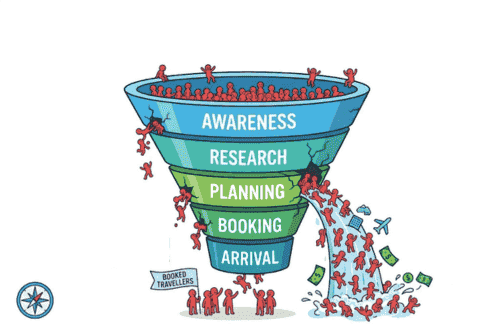
A traveler opens five tabs, compares three OTAs, checks two airline sites directly, and abandons all of them before booking anything. This isn’t an edge case it’s the default behavior in travel search. Industry benchmarks consistently show that online travel booking conversion rates sit in the low single digits, with the vast majority of sessions ending in comparison, not commitment.
For travel aggregators OTAs, metasearch platforms, and hybrid booking engines this creates a peculiar challenge. Unlike a typical e-commerce funnel with three or four steps, travel search involves search, filter, compare, price-check, re-search, abandon, return, and (sometimes) book. Each step is a potential exit ramp, and each exit ramp represents a different reason: price anxiety, indecision, better deals elsewhere, or simply research fatigue.
The traditional response retargeting ads and generic abandoned-cart emails treats every drop-off the same way. But a user who dropped off after comparing five destinations has a completely different intent than one who dropped off at the payment page after selecting seats. Solving this requires knowing the difference, in real time, across every channel the traveler touches. That’s precisely the gap a Customer Data Platform (CDP) is built to close.
Why Point Solutions Can’t Fix Funnel Leakage
Most travel aggregators already have plenty of data a CRM, a web analytics tool, an app engagement platform, an email service provider, maybe a separate ads pixel. The problem isn’t data scarcity; it’s data fragmentation.
A user who searches “Goa flights” on the app, checks hotel prices on the website an hour later, and abandons a cart on the desktop the next day looks like three different people to three different systems. Marketing teams end up sending a “complete your Goa booking” email to someone who already booked through the app, or worse, showing a flight-only ad to a user who was actually browsing package deals. Each of these mismatches erodes trust and pushes the traveler toward a competitor with a more coherent experience.
A Composable CDP addresses this at the source: it unifies identity and behavioral data across web, app, call center, and offline touchpoints into a single customer profile, updated in real time. Once that unification exists, every downstream action personalization, retargeting, pricing nudges is working from the same version of the truth.
Step 1: Search – Turning Anonymous Intent Into Signal

The search stage is where most travelers are anonymous, and it’s also where a CDP’s real-time identity resolution earns its keep. Even before login, behavioral signals searched routes, date flexibility, price sensitivity, device type can be captured and stitched to a probabilistic or deterministic identity as soon as an email, phone number, or login event appears.
This matters because early-stage signals predict late-stage behavior. A traveler repeatedly searching flexible dates for the same route is price-sensitive and time-flexible; a traveler searching fixed dates with premium cabin filters is planning-committed and less price-sensitive. A CDP that captures this at the search stage lets aggregators branch personalization immediately surfacing fare-alert prompts for the former, and premium bundle upsells for the latter instead of applying one generic homepage experience to everyone.
Step 2: Compare and Shortlist – Reducing Choice Paralysis

Comparison is where most travel journeys stall. Travelers open multiple options, and the sheer volume of near-identical choices creates decision fatigue. This is also the stage where aggregators tend to over-rely on discounting as a blunt instrument to force a decision.
With unified profile data, a CDP enables more targeted intervention. Instead of a blanket 10% coupon, the platform can identify that a specific traveler has shortlisted three hotels in the same city and nudge with comparison-relevant content reviews, cancellation flexibility, or loyalty point value rather than price alone. For travelers who’ve shown loyalty-program engagement in the past, non-monetary incentives (upgrade eligibility, priority check-in) often convert better than a discount, and a CDP is what makes that segmentation possible at the individual level rather than a broad cohort.
Step 3: Price Check and Hesitation Timing the Nudge

The price-check-and-leave pattern is notorious in travel. A user finds a fare, leaves to check a competitor or “sleep on it,” and may never return. This is the stage where response timing matters more than message content.
A CDP with real-time event streaming can trigger the right channel within minutes, not hours a push notification if the user has the app installed, an SMS fare-drop alert if not, or a WhatsApp message where that channel is trusted and permissioned. Because the CDP already knows channel preference and past response rates per user (some travelers respond to email, others ignore it entirely but open every push notification), the nudge goes where it’s actually likely to be seen, instead of a one-size-fits-all email blast sent hours after the moment of hesitation has passed.
Step 4: Cart and Checkout Removing Friction, Not Just Reminding

Checkout abandonment in travel is rarely about forgetting it’s about friction: unexpected fees, a confusing seat-selection step, a payment method that fails, or simply a session timeout during a multi-passenger booking.
Here, a CDP’s value shifts from marketing to product intelligence. By tracking exact drop-off points (which form field, which add-on screen, which payment gateway step) at the individual session level, aggregators can identify friction patterns not just “cart abandonment” as one number, but “23% of drop-offs happen at the baggage add-on screen for mobile users.” That’s an actionable, fixable insight rather than a reason to send another discount email. When re-engagement is warranted, the CDP can pre-fill the traveler’s saved preferences (seat type, meal preference, previous payment method) to reduce the number of steps to complete the booking on return.
Step 5: Post-Booking Where Retention Actually Begins

Aggregators often treat booking confirmation as the funnel’s endpoint, but it’s actually the start of the highest-leverage relationship in travel: the repeat booker. A CDP that continues tracking post-booking behavior trip completion, support tickets, review sentiment, ancillary purchases can identify which travelers are primed for a next trip and when.
This is also where a Composable CDP’s architecture advantage shows up directly: because it activates data into existing tools (CRM, ad platforms, WhatsApp, email) rather than locking it into a walled garden, marketing teams can build post-trip win-back sequences, loyalty tier nudges, and destination-based cross-sell all using the same unified profile built during the search-to-booking journey, without duplicating data pipelines for every new channel.
The Common Thread: Real-Time, Unified, Actionable

Across all five stages, the pattern is consistent. Drop-off isn’t one problem with one fix it’s five distinct decision points, each requiring a different signal, message, and channel. What separates aggregators who reduce drop-off from those who keep discounting their way to marginal conversion lifts is the ability to:
- Unify identity across anonymous and known sessions in real time
- Segment based on actual behavior, not just funnel stage
- Trigger the right message on the right channel within the moment of hesitation
- Feed friction data back into product decisions, not just marketing campaigns
- Treat post-booking as the start of the next funnel, not the end of this one
A Composable CDP is the infrastructure layer that makes all five possible simultaneously, because it sits underneath the entire stack web, app, CRM, ad platforms rather than existing as one more disconnected tool competing for the same customer data.
Turning Search Volume Into Booking Revenue
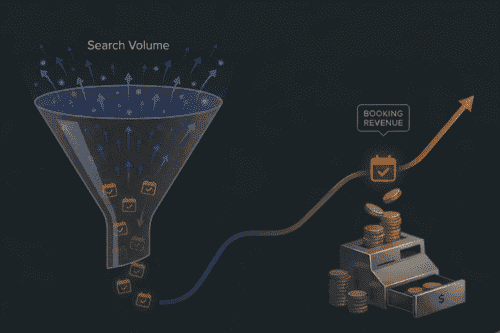
Travel aggregators don’t have a traffic problem. Search volume is high, intent is real, and travelers are actively comparing the challenge is converting that intent before it dissipates across five open tabs. A CDP doesn’t eliminate comparison shopping; it makes sure that when a traveler is ready to decide, your platform is the one with the right message, at the right time, on the right channel built on data that’s actually unified, not fragmented across five different tools guessing at the same customer.

Leave a Reply