Telecom providers face a paradox: they operate some of the most complex infrastructure in the world, yet customers increasingly expect seamless, frictionless experiences. Billing errors, service outages, confusing plans — any one of these can trigger a frustrated call to your contact center and a detractor response on your Net Promoter Score (NPS) survey.

The result? Contact center costs are climbing, customer satisfaction is declining, and operators are caught in a reactive loop — constantly firefighting instead of building loyalty.
Enter the Customer Data Platform (CDP). By unifying customer data across every touchpoint, CDPs give telecom providers the intelligence to get ahead of problems, personalize experiences, and fundamentally shift how customers feel about their provider.
Key Insight: Telecom companies that adopt CDPs report measurable improvements in both NPS scores and operational efficiency – often within the first 12 months of deployment.
Understanding the Problem: High Volume, Low Satisfaction

Telecom contact centers are among the busiest in any industry. Customers call for a wide variety of reasons — and most of them are avoidable:
- Billing confusion or unexpected charges
- Network outages or service disruptions with no proactive communication
- Poor onboarding that leaves customers unsure how to use their plans
- Repeated queries because issues weren’t resolved on first contact
Each of these calls represents a failure in the customer journey. And the cost is double: direct – in terms of agent time and infrastructure – and indirect, through damaged relationships and lower NPS.
Research consistently shows that customers who contact support are more likely to become detractors, especially if their issue isn’t resolved quickly. High call volume and poor NPS are not separate problems. They are two symptoms of the same root cause: fragmented, reactive customer experience.
What Is NPS in Telecom and Why Does It Matter?

Net Promoter Score (NPS) measures customer loyalty by asking a single question: “How likely are you to recommend us to a friend or colleague?” Responses fall into three groups:
- Promoters (9–10): Loyal, enthusiastic customers who drive referrals
- Passives (7–8): Satisfied but vulnerable to competitive offers
- Detractors (0–6): Unhappy customers who can damage your brand through word of mouth
In telecom, NPS matters more than most industries. Switching costs are low, competition is fierce, and customers are increasingly vocal on social media. A single point improvement in NPS has been linked to measurable increases in revenue, retention, and customer lifetime value.
Improving NPS in telecom isn’t just a CX goal — it’s a commercial imperative.
What Is a Customer Data Platform (CDP)?

A Customer Data Platform is a centralized system that collects, unifies, and activates customer data from every channel and touchpoint — in real time. Unlike a CRM (which manages sales and service interactions) or a DMP (which focuses on anonymous ad targeting), a CDP builds persistent, individual customer profiles that can be shared across your entire tech stack.
For telecoms, this means a single, unified view of every customer: their plan, usage patterns, service history, billing behaviour, digital interactions, and support contacts — all in one place, always up to date.
Key CDP capabilities relevant to telecom include:
- Real-time data ingestion from apps, websites, call centers, and network systems
- Cross-channel identity resolution — matching the same customer across devices and channels
- Segmentation and audience building for targeted communications
- Integration with activation tools: marketing platforms, chatbots, IVR systems, and service desks
CDP vs CRM vs DMP: CDPs focus on unified, real-time individual profiles for CX. CRMs manage relationships and sales pipelines. DMPs handle anonymous audience data for advertising.
The CDP–NPS–Contact Center Connection
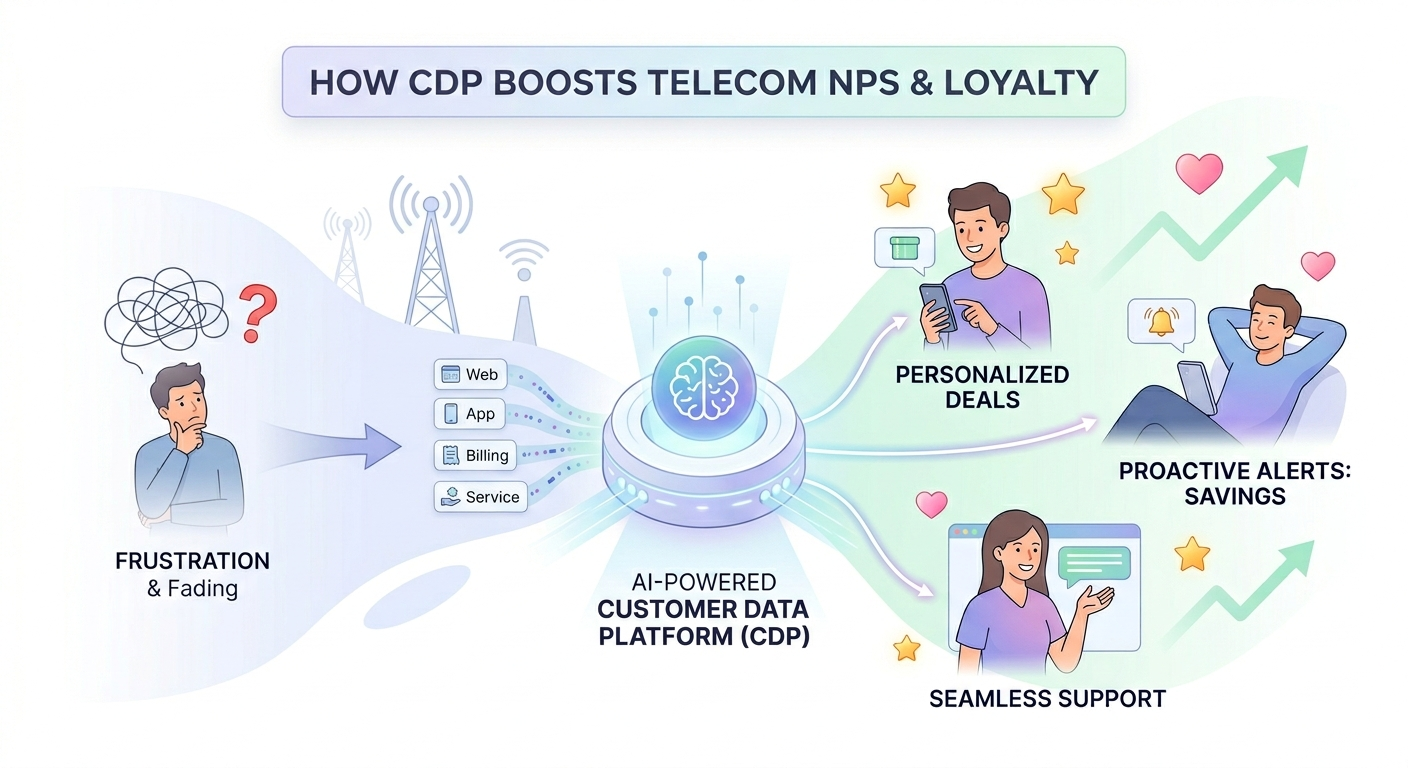
The relationship between CDPs, NPS, and contact center volume is straightforward: better data enables better experiences, which leads to fewer complaints and higher customer satisfaction.
Here’s how the logic flows:
- A CDP gives you a 360° view of each customer’s journey
- That view enables proactive, personalized engagement at every stage
- Proactive engagement prevents issues from escalating into support calls
- Faster, more contextual support reduces repeat contacts and improves first-contact resolution
- Customers who feel understood and well-served become promoters
This is the shift from reactive to proactive CX — and it is only possible with a unified data foundation.
How CDPs Reduce Contact Center Volume
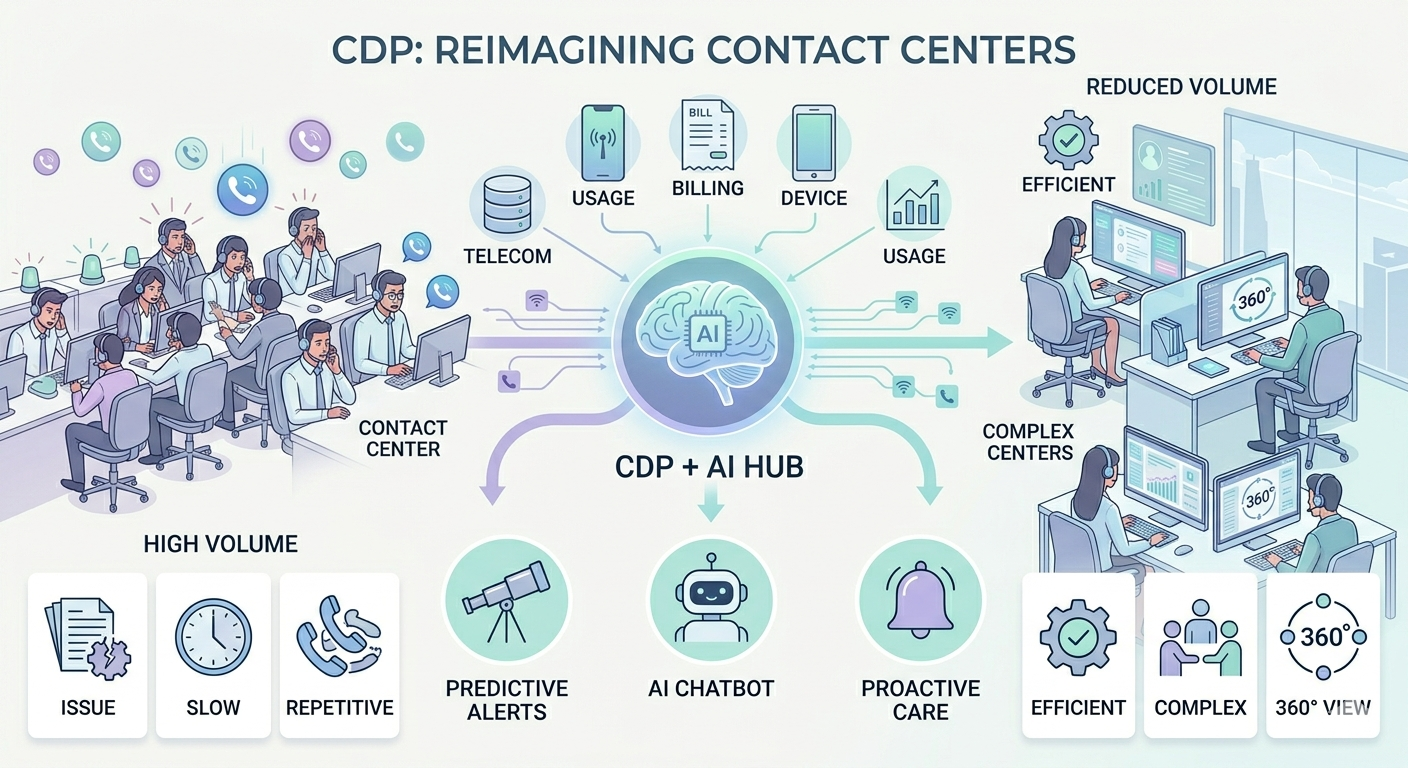
a. Proactive Issue Resolution
One of the biggest drivers of inbound call volume is customers contacting you about something they should have been told about first. Network outages are a prime example. Without a CDP, a provider might only learn about a problem when calls spike. With one, you can detect affected customers in real time and send targeted outage alerts before they reach for the phone.
The same applies to billing anomalies. If a customer’s bill is significantly higher than usual, a proactive notification — with an explanation — can prevent a frustrated call entirely.
b. Personalized Self-Service
Customers are happy to self-serve – if the experience is relevant and easy. CDPs enable telecoms to power chatbots and digital portals with real customer context, so instead of generic FAQs, customers see answers tailored to their plan, usage, and history.
A customer asking “why is my bill higher this month?” shouldn’t have to navigate three menus to find out. A CDP-powered chatbot can surface the answer instantly, based on their actual account data.
c. Omnichannel Consistency
One of the most frustrating customer experiences is being transferred between channels and having to repeat yourself every time. CDPs eliminate this by ensuring every touchpoint — app, website, chatbot, call center — is working from the same customer profile.
This reduces unnecessary calls, shortens handle time, and dramatically improves customer satisfaction when support is needed.
d. Smarter Routing and Faster Resolution
When a customer does call, CDPs enable intelligent routing based on their profile — directing high-value customers to senior agents, routing known technical issues to the right team, and surfacing full context before the agent says hello.
This reduces average handle time, cuts repeat calls, and directly improves first-contact resolution rates.
How CDPs Improve Telco NPS
a. Hyper-Personalization
Hyper Personalization is a missed opportunity in telecom. CDPs enable operators to send the right message, to the right customer, at the right time — whether that’s a plan upgrade recommendation based on usage patterns, a loyalty reward triggered by tenure, or a proactive check-in after a service disruption.
Customers who feel recognized are far more likely to become promoters.
b. Real-Time, Context-Aware Engagement
NPS is heavily influenced by how quickly and relevantly a provider responds to customer moments. CDPs enable real-time event triggers — if a customer experiences a service failure, an automated apology and credit can be issued before they even consider submitting a complaint.
These moments of proactive care have an outsized impact on loyalty.
c. Smoother Customer Journeys
CDPs help identify friction points in the customer journey — the steps where customers consistently drop off, call in, or churn. By analysing these patterns across the full customer base, operators can redesign journeys to remove obstacles and improve satisfaction at scale.
d. Voice of the Customer Insights
When you combine CDP data with feedback signals — NPS surveys, app reviews, social mentions — you can identify exactly which experiences are driving detractors. This allows teams to prioritise improvements based on real customer pain points, not assumptions.
Real-World Use Cases: CDPs in Action for Telecom
While specific vendor data varies, the following scenarios reflect common patterns seen when telecoms deploy CDPs effectively:
- Outage alert automation: A mobile operator identifies customers in an affected area in real time and sends personalised SMS alerts, reducing inbound call volume during incidents by up to 40%.
- Billing transparency campaigns: Customers approaching unusual usage thresholds receive proactive notifications, reducing billing-related contacts by 25–35%.
- Churn prediction and intervention: CDP-driven propensity models identify at-risk customers before they cancel, enabling targeted retention offers that increase save rates significantly.
- Post-service NPS recovery: Customers who experienced a recent service issue are automatically enrolled in a follow-up journey, with gestures of goodwill that improve NPS among previously dissatisfied customers.
The outcome: Telecoms that implement CDPs strategically typically see a combination of reduced inbound contact volume, improved first-contact resolution, higher NPS, and lower churn — driving both cost savings and revenue growth.
Challenges in Implementing CDPs in Telecom

CDP adoption in telecom comes with real organizational and technical complexity:
- Data silos: Telcos often have decades of legacy systems, with customer data fragmented across BSS, OSS, CRM, and billing platforms. Integration is non-trivial.
- Privacy and compliance: GDPR, CCPA, and sector-specific regulations require careful data governance. CDPs must be configured with consent management at the core.
- Organizational alignment: CX, marketing, IT, and network operations often operate independently. A CDP requires cross-functional collaboration to deliver value.
- Time to value: Enterprise CDP implementations can take 6–18 months to fully deploy. Managing expectations and identifying quick wins early is critical to sustaining momentum.
Best Practices for Telcos Adopting a CDP
- Start with high-impact use cases: Identify two or three use cases with measurable ROI — such as outage alerting or billing proactive communications — and build from there.
- Invest in data quality: A CDP is only as good as the data it ingests. Deduplicate, cleanse, and standardise before you activate.
- Align teams early: Bring CX, marketing, IT, and care teams together from day one to define shared outcomes and governance.
- The vendor is ensuring consent and data governance: Your CDP vendor should provide built-in, privacy-compliant data collection, consent management, and audit trails — making governance a platform-level responsibility, not an afterthought.
- Measure continuously: Define your NPS and contact volume baselines before you start, and track improvement quarter-over-quarter. Use these results to secure ongoing investment.
Conclusion: The Data-First Telco Is the Customer-First Telco
For telecoms, the path to higher NPS and lower contact center volume runs through better data. Customer Data Platforms are not just another piece of technology — they are the infrastructure layer that makes genuinely customer-centric operations possible.
When you know who your customers are, what they need, and when they’re struggling, you can get ahead of problems instead of reacting to them. You can deliver personalized experiences that build loyalty. And you can run a more efficient operation — where every contact center interaction adds value rather than resolving an avoidable failure.
The telcos that win the next decade will be the ones that treat data not as a by-product of their operations, but as their most strategic asset.
Ready to explore how Lemnisk’s AI-powered CDP can transform your telecom CX? Talk to a specialist about use cases, integration paths, and the ROI of a CDP deployment tailored to your network and customer base.

Leave a Reply