In today’s data-driven business landscape, Customer Data Platforms (CDPs) have become essential tools for organizations seeking to unify customer information and deliver personalized experiences. However, as technology evolves and business needs become more complex, a new approach has emerged: the Composable CDP. Understanding the differences between Composable and Traditional CDPs is crucial for businesses looking to optimize their customer data strategies.
What is a Traditional CDP?
A Traditional CDP is an all-in-one, packaged software solution designed to collect, unify, and manage customer data from multiple sources into a single, centralized database. These platforms typically come as pre-built systems with integrated features for data ingestion, identity resolution, segmentation, and activation.
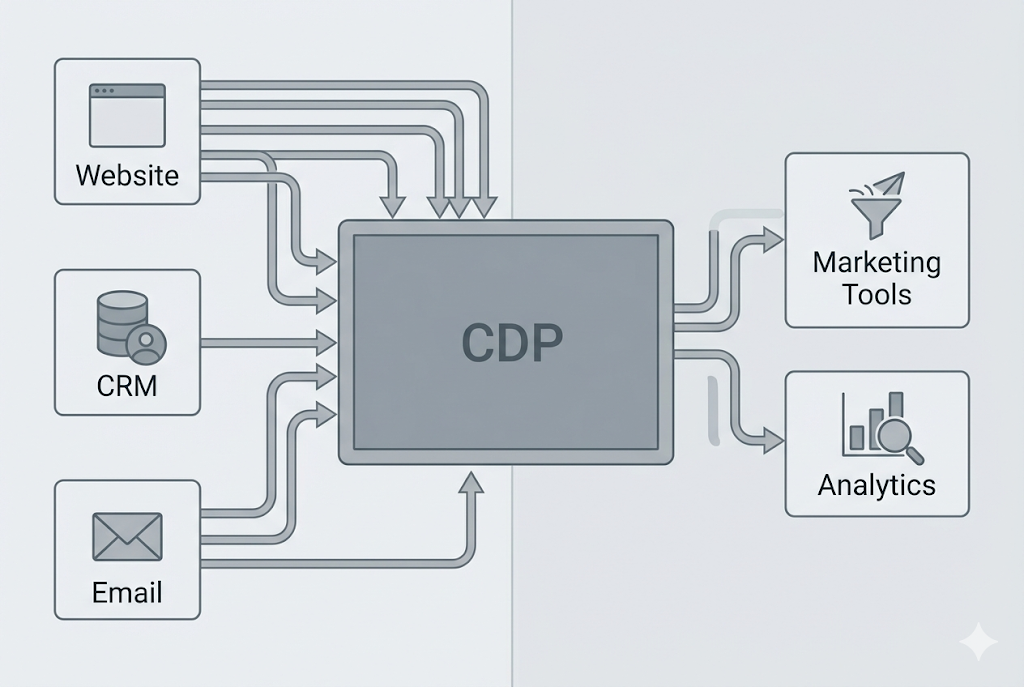
Key Characteristics of Traditional CDPs
- Packaged Solution: Traditional CDPs offer out-of-the-box functionality with pre-configured features and workflows that are ready to deploy with minimal customization.
- Vendor-Managed Infrastructure: The CDP vendor controls the underlying technology stack, data storage, and system architecture, providing a managed service approach.
- Unified Interface: Users interact with a single, proprietary interface for all CDP functions, from data collection to audience activation.
- Built-in Integrations: These platforms come with pre-built connectors to popular marketing tools, CRM systems, and data sources, simplifying the initial setup process.
- Proprietary Data Storage: Customer data is stored within the vendor’s proprietary database system, creating a centralized repository managed entirely by the CDP provider.
What is a Composable CDP?
A Composable CDP represents a modern, modular approach to customer data management. Rather than relying on a single, monolithic platform, a Composable CDP is built by integrating best-of-breed components from your existing data infrastructure such as cloud data warehouses, data lakes, transformation tools, and activation platforms.
The composable architecture leverages your organization’s existing data stack, treating your cloud data warehouse (like Snowflake, BigQuery, or Redshift) as the central source of truth, while adding specialized layers for identity resolution, data modeling, and audience activation.
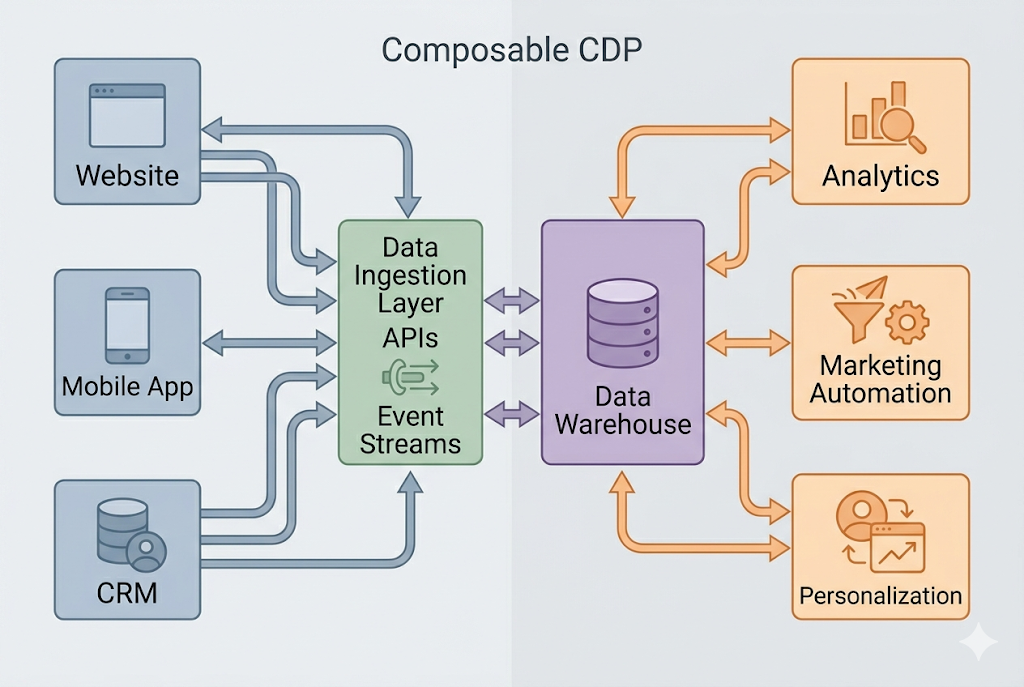
Key Characteristics of Composable CDPs
- Modular Architecture: Composable CDPs are built from interchangeable components that can be selected, configured, and replaced based on specific business needs.
- Data Warehouse-Centric: Customer data lives in your own cloud data warehouse, giving you complete ownership and control over your most valuable asset.
- Best-of-Breed Integration: Organizations can choose the best tools for each function—whether it’s Segment for data collection, dbt for transformation, or Census for reverse ETL—and integrate them seamlessly.
- Flexibility and Customization: Every component can be tailored to your unique requirements, allowing for highly customized data workflows and business logic.
- Open Standards: Composable CDPs typically use open APIs and standard data formats, reducing vendor lock-in and enabling easier migrations.
Traditional CDP vs. Composable CDP: Key Differences
- Data Ownership and Control
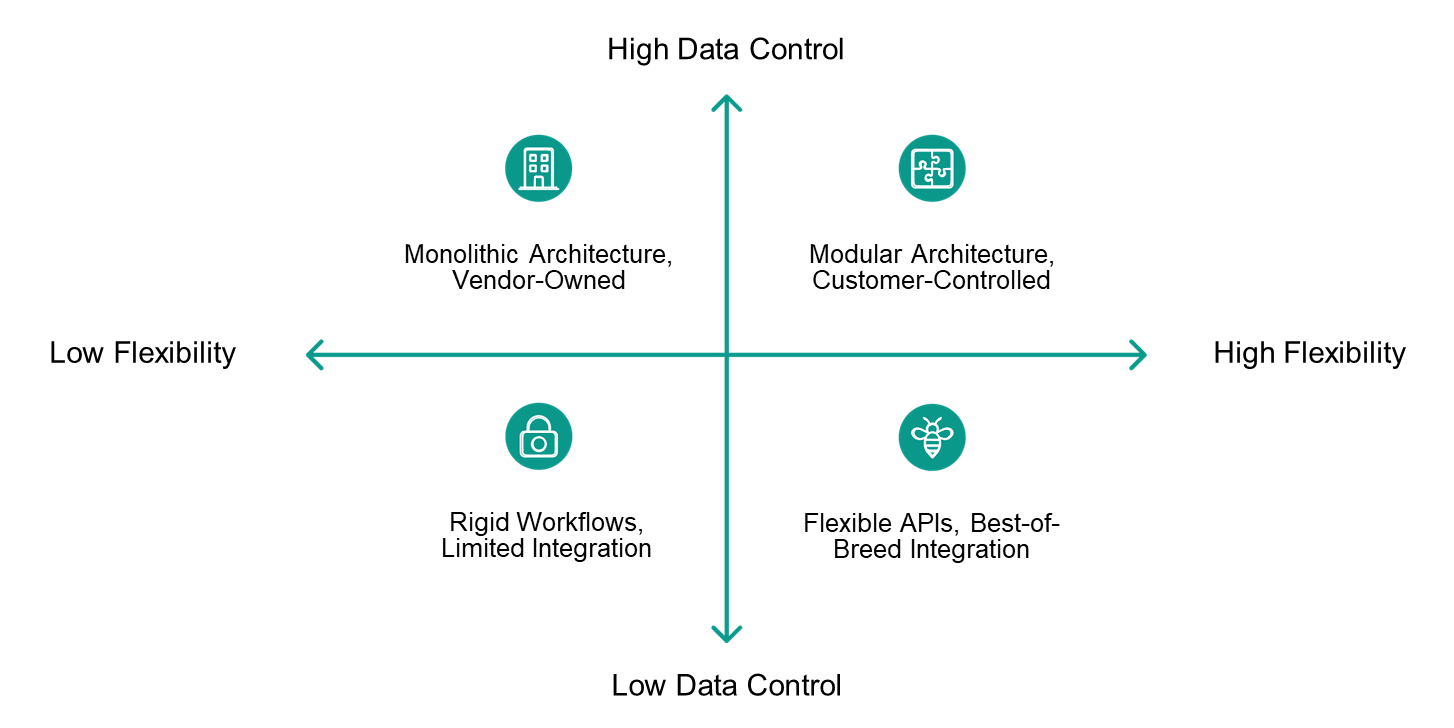
Traditional CDP: Data is stored in the vendor’s proprietary system, which can create concerns about data portability, access, and long-term ownership.
Composable CDP: You maintain complete ownership of your data in your own warehouse, with full control over access, governance, and retention policies.
- Flexibility and Customization
Traditional CDP: Offers limited customization within the boundaries of the platform’s capabilities. Custom requirements often require vendor support or may not be possible.
Composable CDP: Provides unlimited flexibility to build custom data models, create unique identity resolution logic, and implement business-specific workflows.
- Architecture and Infrastructure
Traditional CDP: Operates as a closed, proprietary system where all data processing happens within the vendor’s infrastructure. Your data is extracted from source systems and stored in the CDP’s database.
Composable CDP: Built on your existing data infrastructure, with your cloud data warehouse serving as the foundation. Data remains in your environment, and specialized tools are layered on top for specific functions.
- Implementation and Time-to-Value
Traditional CDP: Generally faster initial deployment with pre-built features and integrations. Can deliver value quickly for standard use cases.
Composable CDP: Requires more upfront planning and integration work but offers greater long-term flexibility and scalability.
- Cost Structure
Traditional CDP: Typically involves subscription fees based on data volume, profiles, or features, with costs that can escalate as your data grows.
Composable CDP: Costs are distributed across multiple tools and your data warehouse infrastructure, potentially offering better economics at scale and more predictable pricing.
- Vendor Lock-in
Traditional CDP: Creates significant vendor dependency, as migrating data and rebuilding integrations can be complex and costly.
Composable CDP: Minimizes lock-in by using open standards and keeping data in your warehouse, making it easier to swap components or change vendors.
- Data Governance and Compliance
Traditional CDP: Relies on the vendor’s governance framework and compliance certifications, which may not align perfectly with your requirements.
Composable CDP: Enables you to implement your own governance policies, compliance controls, and security measures directly on your data infrastructure.
| Aspect | Traditional CDP | Composable CDP |
| Architecture | Monolithic, all-in-one platform | Modular, built using best-of-breed tools |
| Data Storage | Data stored in vendor-controlled system | Data stored in your cloud data warehouse |
| Data Ownership | Limited control (vendor-managed) | Full ownership and control |
| Flexibility | Limited customization within platform constraints | Highly flexible and fully customizable |
| Scalability | Can become expensive and restrictive at scale | Scales efficiently with your data infrastructure |
| Implementation Time | Faster initial setup | Requires planning but offers long-term benefits |
| Vendor Lock-in | High dependency on single vendor | Low lock-in, easy to switch tools |
| Data Freshness | Often relies on batch processing | Real-time or near real-time data access |
| Integration Approach | Pre-built integrations only | Open APIs + flexible integrations |
| Cost Structure | Subscription-based, increases with data volume | Usage-based (warehouse + tools), more predictable |
| Customization | Limited to vendor features | Fully customizable data models and workflows |
| Data Governance | Controlled by vendor policies | Fully controlled by your organization |
| Analytics Capabilities | Limited to platform features | Advanced analytics using your own tools (SQL, ML, BI) |
| Activation | Data exported to external tools | Reverse ETL: activate directly from warehouse |
| Use Case Fit | Best for simple, standard use cases | Ideal for complex, evolving business needs |
| Maintenance | Managed by vendor | Requires internal data expertise |
| Time-to-Value | Quick for basic use cases | Strong long-term ROI and flexibility |
| Future Readiness | Slower to adapt to new tech | Easily adapts to modern data stack innovations |
Advantages of Composable CDPs
For Modern Data-Driven Organizations
- Future-Proof Technology Stack: As new tools and technologies emerge, you can integrate them without replacing your entire CDP infrastructure.
- Enhanced Data Quality: By leveraging modern data transformation tools like dbt, you can implement sophisticated data quality checks and business logic.
- Unified Analytics: With data in your warehouse, analytics teams can access the same customer data used for marketing activation, ensuring consistency across the organization.
- Cost Efficiency at Scale: As data volumes grow, warehouse-based solutions often provide better economics than traditional CDP pricing models.
- Advanced Use Cases: The flexibility of composable architecture enables sophisticated use cases like predictive modeling, real-time personalization, and cross-functional data applications.
Advantages of Traditional CDPs
When Packaged Solutions Make Sense
- Rapid Deployment: Organizations without mature data infrastructure can get up and running quickly with minimal technical resources.
- Simplified Management: A single vendor relationship and unified interface reduce operational complexity for smaller teams.
- Proven Workflows: Pre-built features and best practices are embedded in the platform, reducing the need for custom development.
- Lower Technical Requirements: Less need for specialized data engineering expertise to maintain and operate the system.
Business Implications: Choosing the Right Approach

When to Consider a Traditional CDP
A Traditional CDP may be the right choice if your organization:
- Lacks a mature data infrastructure or cloud data warehouse
- Needs to deploy quickly with limited technical resources
- Has relatively straightforward use cases that align with standard CDP features
- Prefers a managed service approach with minimal operational overhead
- Has a smaller data volume that fits within traditional CDP pricing models
When to Consider a Composable CDP
A Composable CDP is likely the better option if your organization:
- Already has or is building a modern data stack with a cloud data warehouse
- Requires high levels of customization and flexibility
- Values data ownership and wants to avoid vendor lock-in
- Has complex, unique business requirements that don’t fit standard CDP templates
- Operates at scale where warehouse-based economics are more favorable
- Wants to enable multiple teams (marketing, analytics, product) to leverage the same customer data
The Hybrid Approach
Some organizations adopt a hybrid strategy, using traditional CDP features for specific functions while building composable elements for others. This approach can provide a migration path from traditional to composable architectures over time.

The Future of Customer Data Platforms
The shift toward composable architectures reflects broader trends in enterprise technology: the move to cloud-native infrastructure, the rise of the modern data stack, and the increasing importance of data ownership and governance. As organizations become more sophisticated in their data capabilities, the flexibility and control offered by composable approaches become increasingly valuable.
However, traditional CDPs continue to serve an important role, particularly for organizations that prioritize speed of deployment and simplicity over customization. The key is understanding your organization’s current capabilities, future goals, and strategic priorities.
Making the Right Choice for Your Business
Selecting between a Composable CDP and a Traditional CDP isn’t about choosing the “better” technology, it’s about finding the right fit for your organization’s unique context. Consider these factors:
- Current Infrastructure: What data systems do you already have in place?
- Technical Capabilities: What level of data engineering expertise exists in your organization?
- Business Requirements: How unique or complex are your customer data needs?
- Timeline: How quickly do you need to deliver value?
- Budget: What are your cost constraints and how do they scale with data growth?
- Strategic Vision: Where do you want your data capabilities to be in 3-5 years?
Conclusion
The shift toward composable architectures reflects broader trends in enterprise technology: cloud-native infrastructure, the rise of the modern data stack, and the increasing importance of data ownership and governance. As organizations become more sophisticated in their data capabilities, the flexibility and control offered by composable CDPs become increasingly valuable.
While Traditional CDPs continue to serve organizations that prioritize simplicity and rapid deployment, forward-thinking businesses are turning to Composable CDPs for long-term scalability, real-time personalization, and advanced analytics. Lemnisk’s Composable CDP allows your teams to unify customer data directly in your cloud data warehouse, giving you full control, flexibility, and the ability to activate data seamlessly across marketing, product, and sales.
Whether you’re looking to optimize campaigns, improve customer experiences, or gain deeper insights into your audience, Lemnisk makes it easier to transform your data into action.
Take the first step today. Get a Demo to explore how Lemnisk’s Composable CDP can power your business growth.

Leave a Reply