The modern car buyer’s journey rarely follows a straight line. A prospect might browse models on a brand’s mobile app, walk into a dealership for a test drive, call customer support about a service query, and then return to the app to book a service appointment. Each of these touchpoints generates valuable data, but in most automotive companies, that data lives in disconnected systems that never talk to each other.
This fragmentation is the single biggest obstacle to delivering personalized, consistent experiences in automotive. The solution is a Customer 360 view: a unified profile that stitches together dealership, app, and call center data into one coherent picture of each customer.
Why Automotive Brands Struggle with Fragmented Data

Automotive customer data is uniquely scattered across:
- Dealership management systems (DMS) that track test drives, purchases, trade-ins, and service history at the point of sale
- Mobile apps that capture browsing behavior, configurator usage, push notification engagement, and service booking activity
- Call centers and contact centers that log service complaints, roadside assistance requests, and warranty queries
- Telematics and connected car platforms that generate vehicle usage and diagnostic data
- Marketing systems running campaigns across email, social, and paid channels
Each of these systems was typically built to serve a single function, not to share data. A dealership’s DMS doesn’t know that a customer downloaded the brand’s app last week. A call center agent has no visibility into the fact that the same customer configured a new vehicle online just days earlier. The result is disjointed, sometimes contradictory communication, missed cross-sell opportunities, and a frustrating customer experience.
What Customer 360 Means in an Automotive Context

A Customer 360 platform pulls data from every one of these sources and resolves it into a single golden record per customer or household. For automotive specifically, this typically means stitching together:
- Identity data: name, contact details, loyalty IDs, vehicle ownership records
- Transactional data: vehicle purchases, financing details, trade-ins, accessory purchases
- Service data: appointments, repair history, warranty claims, parts orders
- Digital behavior: app sessions, configurator choices, website visits, push notification responses
- Support interactions: call transcripts, complaint categories, resolution outcomes, CSAT scores
- Vehicle telemetry: mileage, diagnostic alerts, driving patterns (where available)
When these sources are unified, a sales associate, service advisor, or marketing team gains a complete view of the customer relationship, not just a fragment of it.
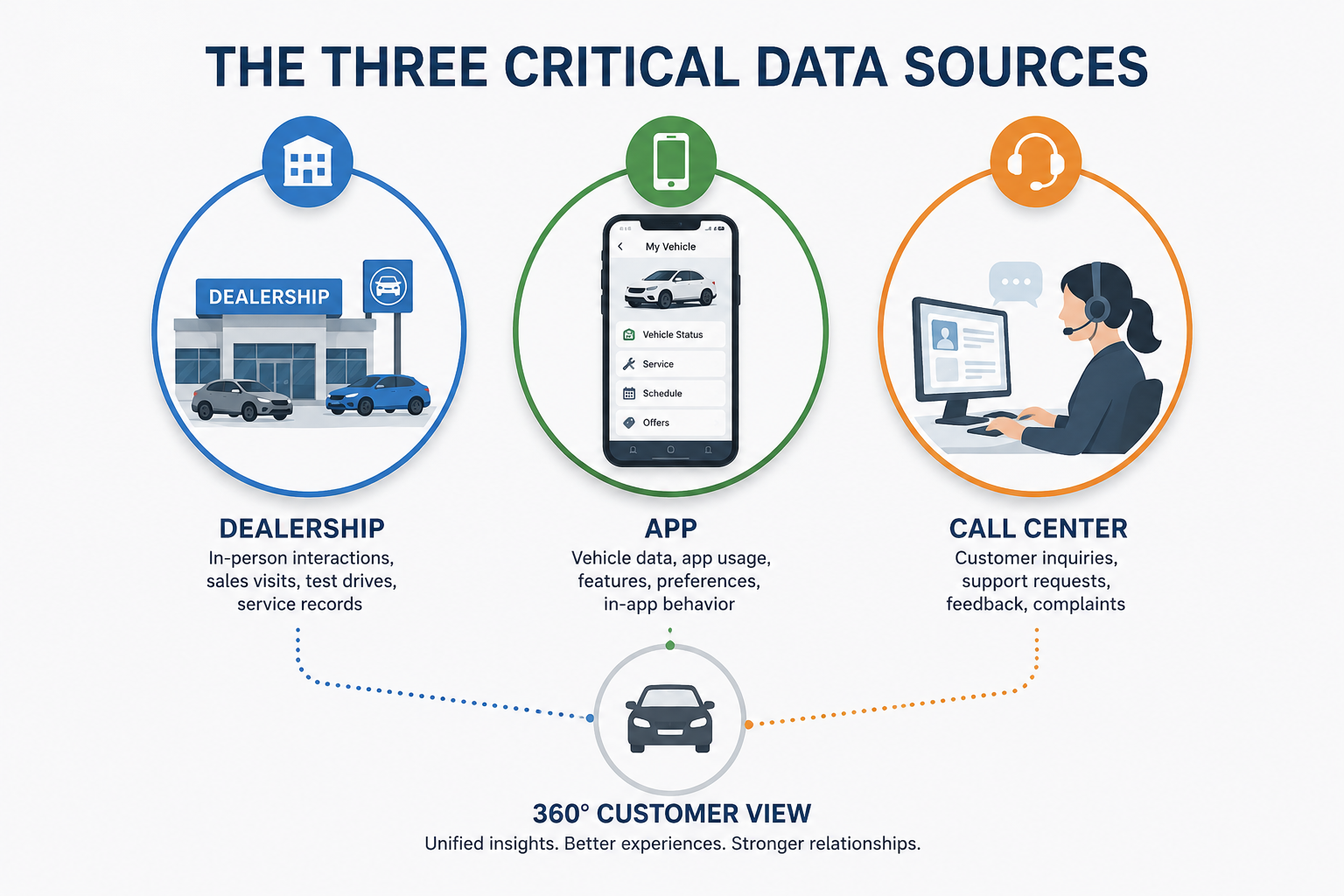
The Three Critical Data Sources: Dealership, App, and Call Center
Dealership Data
Dealerships are often the richest source of high-intent signals: test drives, financing applications, trade-in valuations, and final purchase details. But dealership systems are frequently siloed by location or by dealer group, especially in franchise models. Without integration, a customer who test-drives a vehicle at one dealership location may receive a generic, untargeted offer from a completely different outlet.
Stitching dealership data into a Customer 360 platform means every interaction at every location feeds into the same profile, so any dealer or digital channel can pick up the relationship exactly where it left off.
App Data
Mobile apps have become the primary digital front door for automotive brands, used for everything from vehicle configuration to service scheduling to EV charging status. App data reveals intent signals long before a customer ever steps into a showroom, such as repeated visits to a specific trim or color, or abandoned configurator sessions.
When app behavior is connected to dealership and call center records, brands can trigger timely, relevant nudges. For instance, a customer who configured a vehicle but didn’t complete a purchase can be routed to the right dealer with the exact configuration already on file, rather than starting the conversation from scratch.
Call Center Data
Call centers capture some of the most emotionally significant moments in the customer relationship: breakdowns, warranty disputes, and service complaints. This data is also some of the most underutilized. Without integration, a customer who recently filed a complaint might still receive a marketing email promoting a new model, which can come across as tone-deaf and damage trust.
By connecting call center data to the broader Customer 360 profile, brands can suppress inappropriate campaigns, prioritize service recovery, and identify patterns, such as recurring complaints about a specific model or part, that inform both customer experience and product teams.
How a Composable CDP Enables Automotive Customer 360
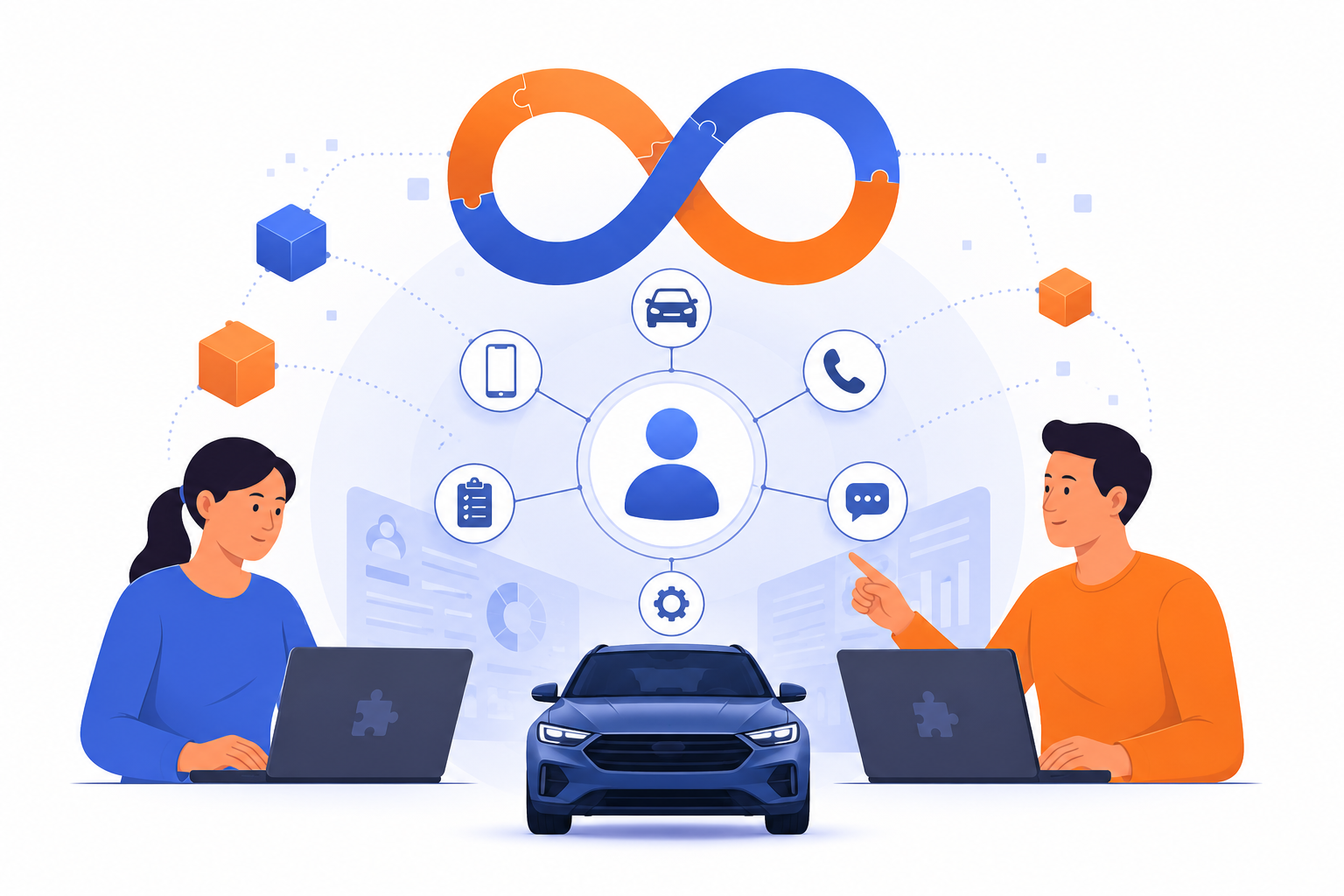
Traditional approaches to unifying this data often involve heavy, multi-year data warehouse projects or rigid all-in-one platforms that are difficult to adapt as new data sources emerge. A Composable Customer Data Platform takes a different approach, integrating with the systems automotive companies already use rather than forcing a rip-and-replace. By creating a unified, trusted Customer 360 profile, it enables downstream marketing, sales, and service systems to deliver more relevant customer experiences while preserving existing technology investments.
While a composable Customer 360 provides the foundation, enterprise automotive brands increasingly require platforms that also support native streaming, real-time identity resolution, AI-driven decisioning, and low-latency activation. This combination enables customer data to move from insight to action in seconds rather than relying solely on scheduled synchronization, making it possible to deliver truly event-driven customer experiences.
Key capabilities that make this possible include:

Identity Resolution Across Channels
Automotive customers interact under different identifiers across systems, a phone number at the call center, an email in the app, a loyalty ID at the dealership. Advanced identity resolution matches these fragmented identifiers into one accurate, deduplicated customer profile, even across multiple vehicles or family members sharing an account.
Real-Time Data Activation
A Customer 360 view is only valuable if it can be acted on quickly. When combined with event streaming, APIs, and real-time activation systems, a composable architecture can make unified customer profiles available for low-latency decisioning across channels. This enables scenarios such as a call center agent viewing a customer’s recent app activity during a live call, or a service reminders being triggered automatically based on telematics data and past service history.
Flexible Integration with Existing Systems
Rather than requiring automotive companies to migrate off their DMS, CRM, or telematics platforms, a composable architecture connects to these systems via APIs and pre-built connectors. This significantly reduces implementation time, lets brands keep the specialized tools their dealership and service teams already rely on, and provides the flexibility to evolve activation and engagement capabilities independently as business requirements change
Privacy-Compliant Data Governance
With customer data spanning purchase history, location, and even driving behavior, automotive brands need strong consent management and governance built into the platform, ensuring data is used appropriately across regions and regulatory frameworks.
Business Outcomes of a Unified Customer 360

Automotive brands that successfully stitch together dealership, app, and call center data typically see measurable improvements in:
- Cross-sell and upsell conversion, since service history and app behavior can surface relevant accessory, warranty, or upgrade offers
- Service retention, by enabling timely outreach based on telematics alerts, service due dates, and customer behavior when integrated with real-time engagement systems.
- Customer satisfaction, by avoiding tone-deaf marketing during active complaints and personalizing every interaction with full context
- Dealer network efficiency, since leads and customer history transfer seamlessly between locations and digital channels
- Marketing ROI, through more precise audience segmentation built on real purchase and behavior data rather than guesswork
Getting Started with Automotive Customer 360
Building a true Customer 360 view doesn’t require a multi-year overhaul. Automotive brands can start by:
- Mapping existing data sources across dealership, app, call center, and telematics systems
- Identifying the highest-impact use case, such as service retention or post-complaint marketing suppression, as a pilot
- Choosing a composable platform that integrates with existing systems instead of replacing them
- Establishing clear identity resolution rules to merge customer records accurately
- Scaling customer engagement and activation use cases progressively by integrating streaming events and downstream engagement platforms as the Customer 360 foundation matures.
Conclusion
In automotive, the brands that win customer loyalty are the ones that recognize a customer across every touchpoint, not just within a single system. Stitching together dealership, app, and call center data into a true Customer 360 view turns fragmented interactions into a coherent, personalized relationship. With a Composable CDP, automotive companies can achieve this without disrupting the specialized systems their teams already depend on.
By combining this unified customer foundation with modern activation and engagement technologies, automotive brands can deliver more contextual experiences, improve retention, increase conversion, and strengthen customer trust across every touchpoint.
Ready to connect every dealership, app, and service interaction into one intelligent customer journey? Explore how Lemnisk can help!

Leave a Reply